Sleeping in a Rental Car Packing List: 3.8kg Carry-On Kit
Everything below flies carry-on. Renting a car means flying there first, so weight and size decide what makes the packing list. Many full-service airlines include a larger carry-on, while low-cost airlines like Ryanair, Wizz Air, and easyJet charge extra for it:
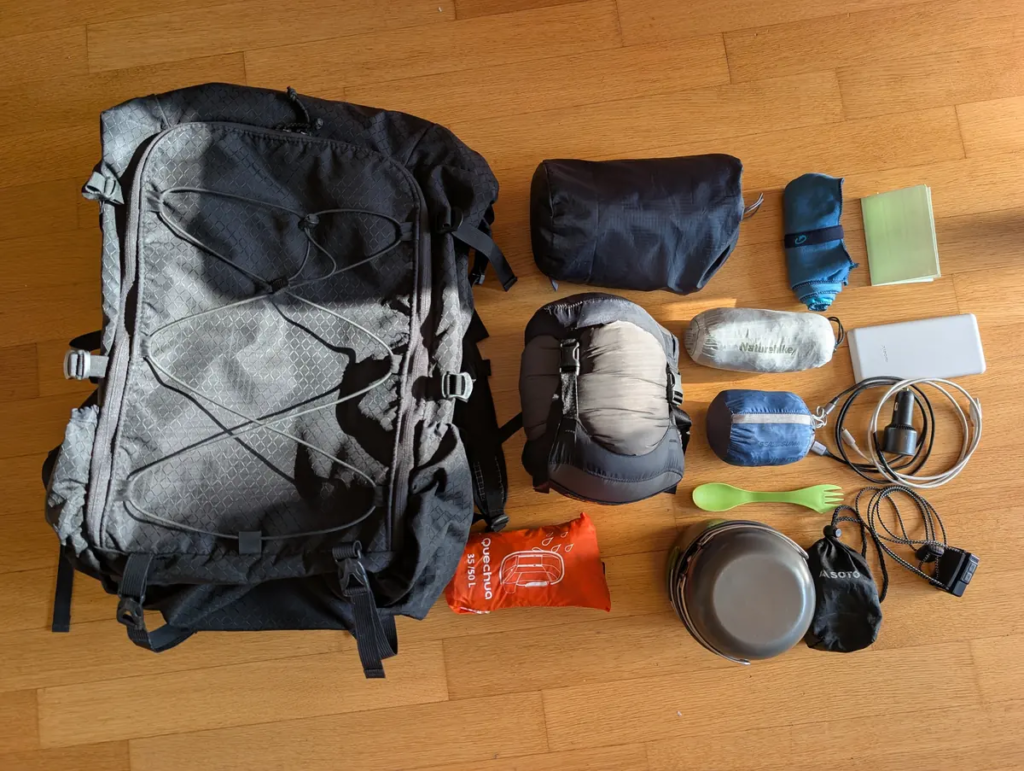
The essentials are a sleeping pad, a warm sleeping bag, a car charger, charging cables, and a backpack (ULA Camino). They weigh around 2.5kg. The optional items (liner, pillow, power bank, stove, and more) add around 1.3kg, so the full kit is around 3.8kg (8.3lb).
Clothes and other extras aren’t included. For sleeping spots and the full setup: Sleeping in Rental Cars. For the rules country by country: Is It Legal to Sleep in a Rental Car in Europe?
Weights and Costs
Essentials:
| ITEM | BRAND + MODEL | WEIGHT | PRICE (2026) |
|---|---|---|---|
| Sleeping pad | Therm-a-Rest NeoAir XLite Regular | 400g | ~€187 |
| Sleeping bag | Sea to Summit Spark -1C Long | 620g | ~€394 |
| Backpack | ULA Camino | 1,340g | ~€267 |
| Car charger | JOYROOM 120W | 45g | ~€23 |
| Charging cables (2) | 1 x USB-C to USB-C 1 x USB-A to USB-C | 60g | ~€10 |
| Essentials total | 2,465g |
Optional:
| ITEM | BRAND + MODEL | WEIGHT | PRICE (2026) |
|---|---|---|---|
| Sleeping bag liner | Naturehike Flame ZY20 | 128g | ~€21 |
| Inflatable pillow | Sea to Summit Aeros Premium L | 110g | ~€50 |
| Window covers | (no brand) | 230g | ~€9 |
| Power bank | Xiaomi 10,000mAh | 230g | ~€15 |
| Headlamp | Nitecore NU20 Classic | 40g | ~€20 |
| Stove | SOTO WindMaster | 96g | ~€62 |
| Cooking pot | (no brand) | 300g | ~€12 |
| Spork | (no brand) | 7g | ~€5 |
| Towel | Decathlon Microfiber Size S | 40g | ~€3 |
| Rain cover | Decathlon 40/60L | 115g | ~€9 |
| Optional total | 1,296g |
Full kit: 3,761g with the Camino.
Current prices are from EU and UK shops. I always search for deals – I paid €302 for the Spark -1C in 2026 and around €124 for the NeoAir XLite in 2014.
Carry-On Bag
ULA Camino. 1,340g, 36L (54L with the roll-top extended). At 56×33×21cm (22×13×8in) with the roll-top down, it’s designed to fit the standard larger carry-on. I extend the roll-top at my destination if I pick up extra food.
It’s a soft pack and it compresses. I have flown with it more than 20 times, and no airline has ever measured it. When I’ve checked it myself, it has always fit in a baggage sizer. I’ve flown it on Southwest, Hawaiian, Norse, easyJet, Ryanair, Wizz Air, and Spirit.
With the kit inside, the Camino comes to around 3.8kg. That leaves around 6.2kg for clothes and toiletries under the 10kg limit (4.2kg under LOT’s and Lufthansa’s 8kg limit). My packed Camino stays well within both. Carry-on limits for selected airlines are at the end of this page.
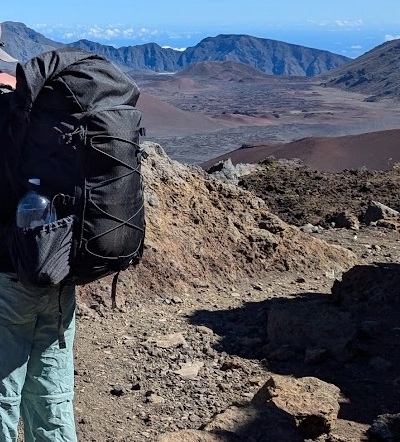
Rain Protection. Decathlon backpack rain cover, 40/60L, 115g. It fits the Camino both rolled down and extended. It’s usually enough for rain on a car trip.
On hiking trips where everything gets wet, a pack liner is more reliable. Mine is a trash compactor bag (around 60g), which is standard practice among experienced hikers. It keeps the sleeping bag and one set of dry clothes dry. A regular garbage bag tears in a trip or two.
Smaller Carry-On
Quechua Arpenaz 100. 20L, 46×20×25cm, 440g. ~€12 at Decathlon. When I only fly with a smaller carry-on (the free allowance in European low-cost airlines), I take this very popular backpack. It’s 6cm higher than the 40×30×20cm free bag limit on Ryanair and Wizz Air, but it’s soft and bends easily.
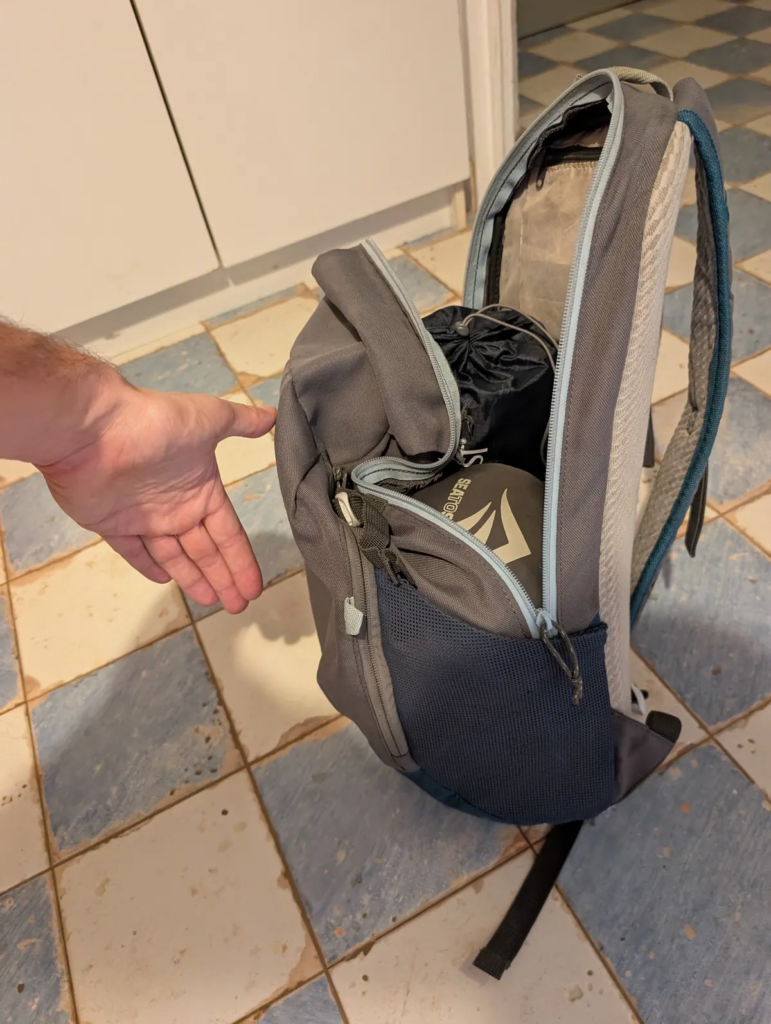
The essentials fit: pad, sleeping bag, charger, and cables (1,125g). With the backpack that comes to 1,565g.
Sleep System
Sleeping Pad
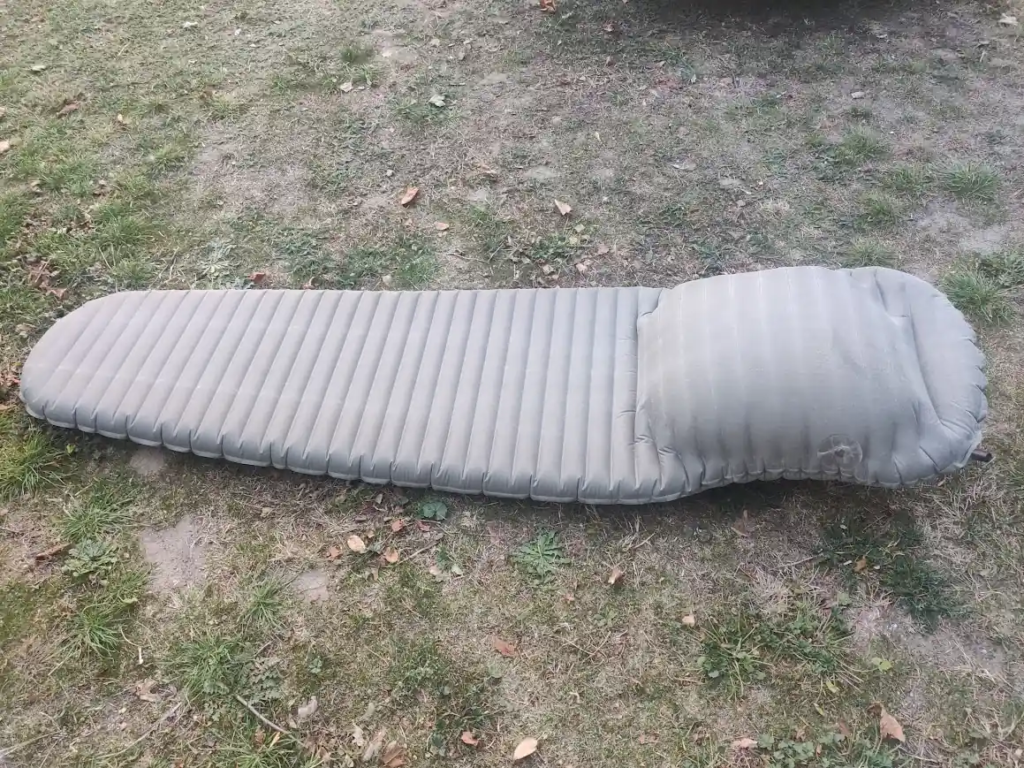
Therm-a-Rest NeoAir XLite. This is the pad I recommend. The current XLite NXT in Regular weighs around 350g (400g with a storage bag), has an R-value of 4.5 (insulation rating), and is 183cm long. I bought my first XLite in Canada in 2014 for around €124. The price has since gone up.
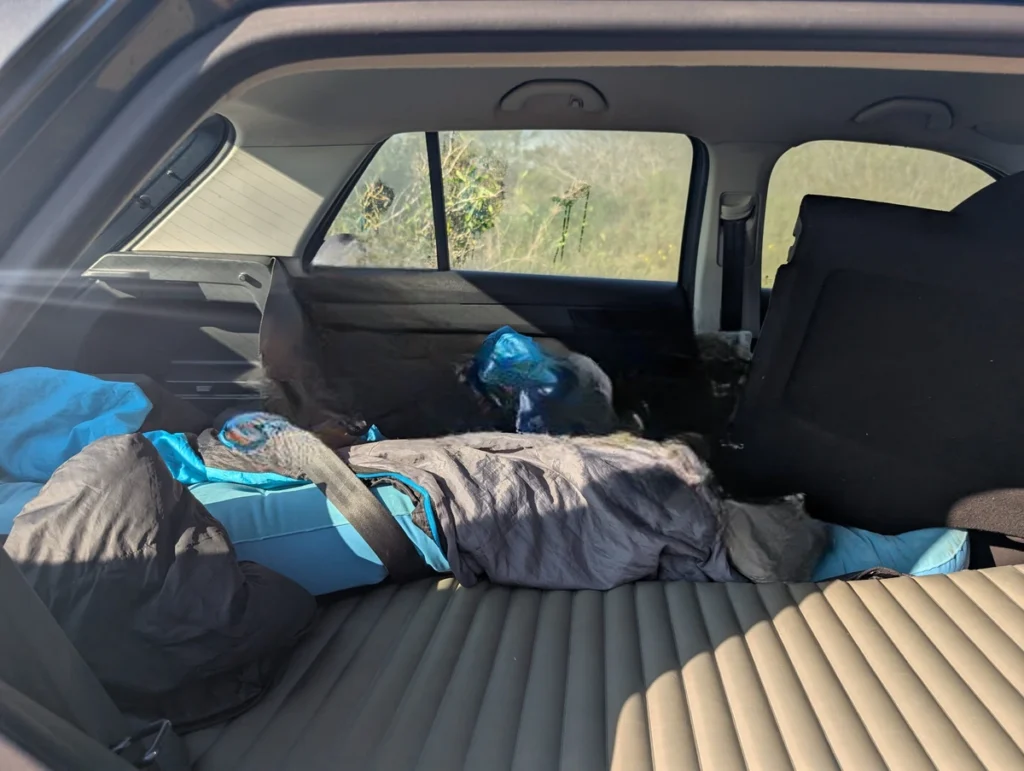
At my height of 190cm, Regular is slightly short. Large would have been better. In small cars I push the foot end of the pad between the front seats, which gets me an extra 50cm of sleeping space. More in Best Rental Cars to Sleep In.
Warranty: Outstanding. Therm-a-Rest replaced my pad twice because it started to delaminate. The first time was in New Zealand in 2021, after 7 years of use. The second was in Poland in 2025, after 4 years with the replacement. The 2025 replacement was a free upgrade to the XTherm NXT (slightly heavier, but warmer at R-value 7.3). They also fixed a tricky leak in my pad free of charge in Australia in 2023. Therm-a-Rest covers its sleeping pads with a Limited Lifetime Warranty, and repairs or replaces defective ones at its own discretion. I never needed to provide my original receipt, they just asked for some details (where and when I originally purchased it). I only had to cover one-way shipping. Each claim took up to 2 weeks.
Sleeping Bag
Sea to Summit Spark -1C, Long. 536g (620g with the storage bag), 850+ cuin down (fill power), fits users up to 198cm.
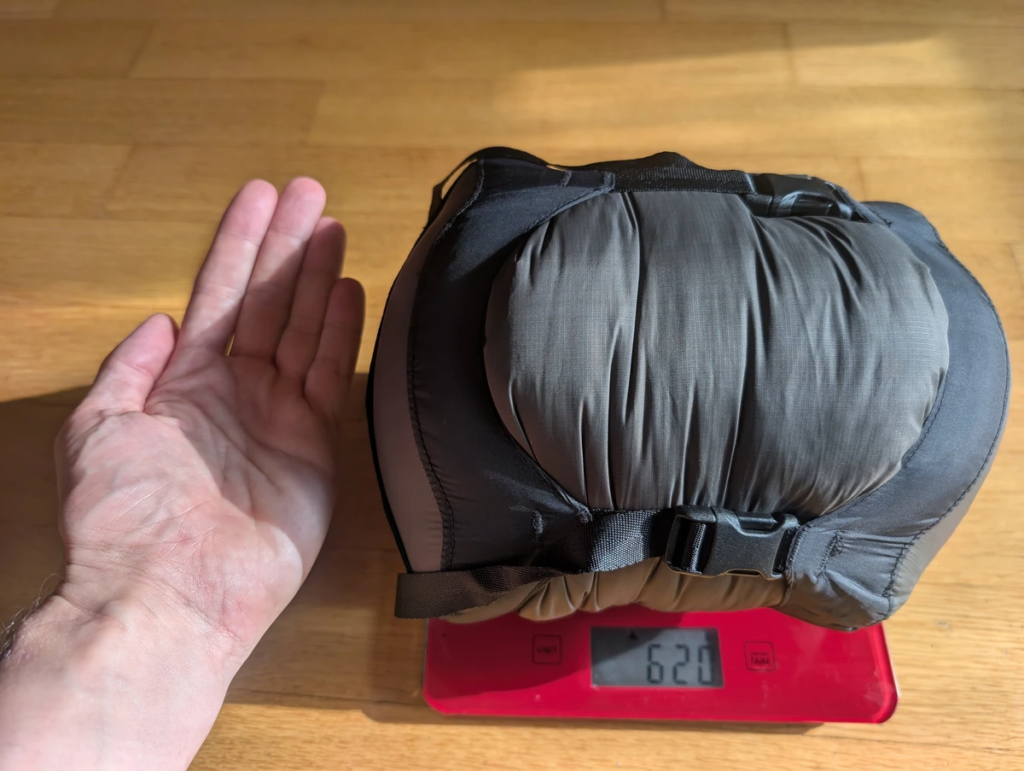
The name is a bit misleading. -1°C (30°F) is the limit rating, not the comfort rating. Comfort is 4°C (39°F). Compare bags by the comfort number. My coldest night in it was 1°C (34°F). I had to dress up to feel warm, socks especially. That matches the comfort rating.
I’ve taken it to Norway. It’s a solid choice, but there are plenty of other ultralight bag models in this weight range that do the same job.
My previous bag was a Yeti Boulder 300, bought in 2011 for around €134. 700 cuin down, 760g, rated 0°C comfort. I used it for 15 years and it visibly degraded. Early on I even slept in it on snow without a tent. After years of usage, I’d get cold in 5–7°C (41–45°F).
Cost per Year. I buy gear that lasts. It might cost more upfront, but less per year.
| ITEM | PAID | YEARS OF USE | PER YEAR |
|---|---|---|---|
| Therm-a-Rest NeoAir | ~€124 | 12+ years 2014– | ~€10 |
| Yeti Boulder 300 | ~€134 | 15 years 2011–2026 | ~€9 |
Therm-a-Rest replaced the pad for free in 2021 and 2025, so the €124 covers three pads. The Spark -1C is a new purchase, so there’s no real number yet. If it lasts as long as the Yeti, it will come to around €20 a year.
Sleeping Bag Liner
Naturehike Flame ZY20 Ultralight. 128g, 80×210cm, nylon, packs to a 6×15cm roll. Adds around 1–2°C. I carry it for two reasons. First, I wash the liner instead of the bag. Washing a sleeping bag is a hard task and not good for its longevity. Second, in warmer climates the liner alone can be enough for the night and save you from sweating.
Pillow
Sea to Summit Aeros Premium, Large. 110g with the stuff sack. I used to travel without one. At 110g, it adds comfort and lets me sleep much better for very little weight. On my Poland trip, the pillow fit in the gap between the front seats: Full Poland Coast trip report.
Sleep Clothes
Warm nights: boxers only. Less weight, less laundry. Not everyone likes it. Colder nights: I pack thermal clothes.
Mesh Window Covers
Dark, lightweight mesh covers for the car windows. I crack two windows for airflow, and the mesh keeps mosquitoes out and adds privacy. Around 230g for a pair. No brand, generic ones from Amazon or AliExpress will do fine.
Earplugs and Eye Mask
For safety, I don’t use either. I want to be aware of my surroundings.
Charging and Light
Car Charger and Cables
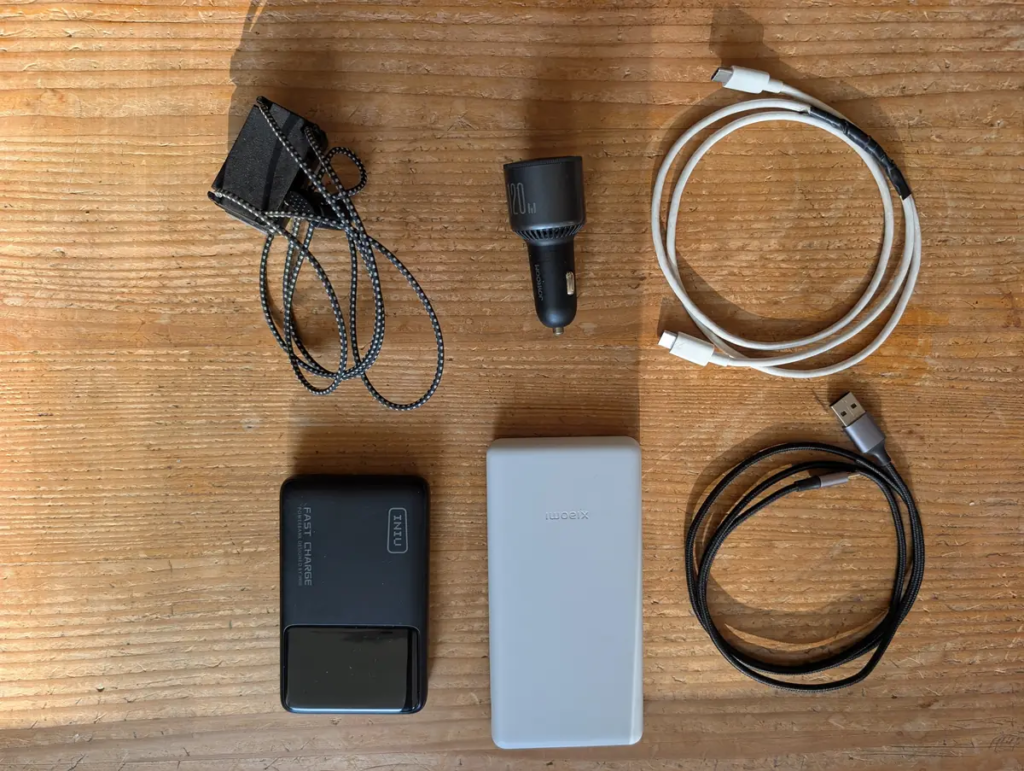
JOYROOM 120W car charger. Two USB-C ports and one USB-A, 45g. At least two fast-charging ports matter to me. Plenty of chargers do the job, but read the reviews closely. Newer cars usually have their own charging ports, but I carry the charger to be safe. I carry two 30g cables, USB-C to USB-C and USB-A to USB-C, to cover different standards.
Power Bank
Xiaomi 10,000mAh. 230g. I tested it, and the real output was 6,200mAh – 62% efficiency. 60–70% efficiency is standard for power banks. It charges my phone 1.4 times.
I tested it against an INIU 10,000mAh (from Amazon). The Xiaomi came out 3% ahead on output, but the INIU is 47g lighter at 183g. I still use the Xiaomi for the reliability a big brand brings. It also cost me only €12.
On normal trips I take one bank. On longer overnight hiking trips, I take two. Power banks are allowed in carry-on only, not in checked luggage.
Headlamp
Nitecore NU20 Classic. 40g with the headband, USB-C rechargeable. It replaced my Nitecore NU25 UL, which died after getting soaked when I slept in my tent in a crazy downpour. I stayed with Nitecore, one of the most recommended headlamp brands on r/ultralight.
Cooking
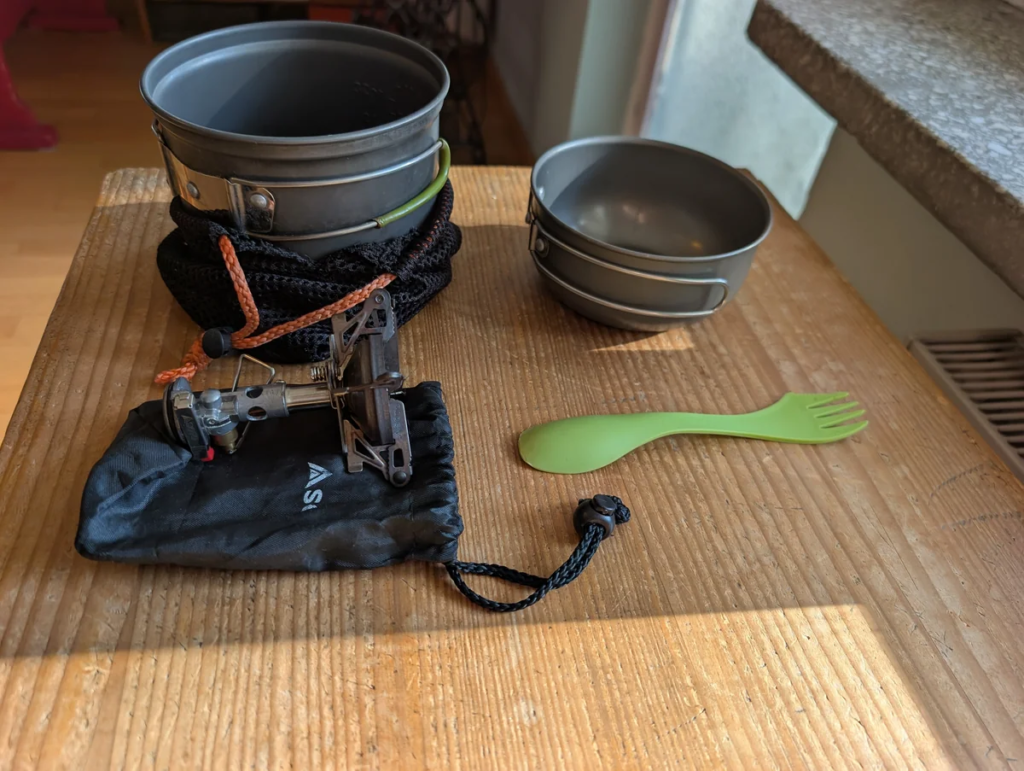
- Stove: SOTO WindMaster. 96g. It’s one of the most recommended stoves on r/ultralight – light, and it uses gas efficiently. The gas canister (threaded, EN 417) can’t fly, so I buy one on arrival. Check local fire bans before cooking, especially in summer.
- Pot: No brand, aluminum, 300g with its bag, marked 1,000ml. A 230g gas canister fits inside it, with the stove and the spork on top. Any pot around that size does the same job.
- Spork: 7g. It cost a few euros for a 4-pack. My pocket knife stays home when I fly carry-on only.
Toiletries and Laundry
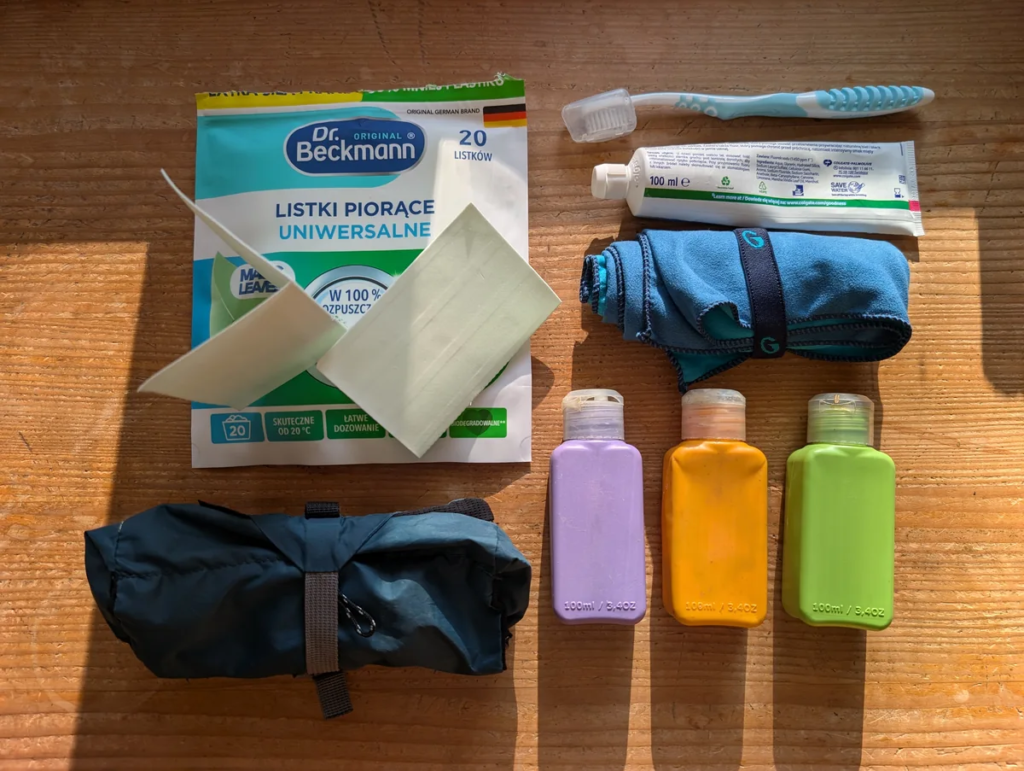
- Liquids: Toothpaste, shampoo, sunscreen SPF50, and mosquito spray, all 100ml max for carry-on.
- Toothbrush Cover: A tiny plastic cap over the brush head. I got a 4-pack for €3.
- Toiletry Bag: Forclaz Ultra Light and Compact from Decathlon. 43g, three compartments, folds to 18×8×3cm. ~€12.
- Travel Bottles: A couple of 100ml bottles from IKEA for things like shampoo and sunscreen. ~€10.
- Wet Wipes: For hikes and days without a shower. A pack of 50 costs €1–€2.
- Towel: Decathlon microfiber towel, size S, 39×55cm, double-sided. 40g.
- Laundry Sheets: I pick them up at a hypermarket at home (~€4 for a pack of 20) and take as much as I need in a ziplock bag. One sheet does a load, and half is enough for a small one. I wash at laundromats about once a week. They’re easier to handle than powder, with no container and nothing to spill. Sheets are solid, so they don’t need to come out at airport security.
Bought on Arrival
- 5L Water Bottle: I usually get two (€1–€2 each) and refill them at public fountains. Organic Maps shows drinking water sources.
- Gas Canister: Only if I cook. Around €5–€8 for a 230g screw-in canister at Decathlon, Leroy Merlin, or any large hypermarket. In some countries where camping isn’t so popular, they’re harder to find and cost more.
- Cardboard Boxes: Free from supermarkets. Sometimes I need them to level the folded seats, like on São Jorge in the Azores. The sturdier, the better: Full Pico/Faial/São Jorge trip report.
Which Airlines Include a Larger Carry-On
- Cheapest Fare: British Airways, Jet2, LOT, Southwest, Norse, and Hawaiian include it.
- Higher Fares Only: Lufthansa, Norwegian, and Aer Lingus.
- Paid Add-On: Ryanair, Wizz Air, easyJet, Vueling, and Frontier.
Check the fare, not just the airline. How I search for cheap flights: Budget Travel Tips.
The Camino is 56×33×21cm. It fits the limits at British Airways, Jet2, Southwest, Norse, Hawaiian, easyJet, and Frontier. At the airlines with a 55cm bag it’s 1cm over on length, and at Ryanair and Vueling it’s 1cm over on depth as well. The pack is soft and compresses, so the 1cm difference has never been an issue.
Airlines marked (tested) are ones I’ve flown it on. Checked October 2026 against the airlines’ own pages, but limits and fees change, so recheck before you book.
| AIRLINE | LARGER BAG | CHEAPEST FARE |
|---|---|---|
| British Airways | 56×45×25cm 23kg | Included |
| Jet2 | 56×45×25cm 10kg | Included |
| LOT | 55×40×23cm 8kg | Included |
| Southwest (tested) | 61×41×25cm No weight limit | Included |
| Norse (tested) | 56×45×25cm 10kg | Included |
| Hawaiian (tested) | 56×36×23cm 11.5kg | Included |
| Lufthansa | 55×40×23cm 8kg | Light (and up) |
| Norwegian | 55×40×23cm 10kg | LowFare+ (and up) |
| Aer Lingus | 55×40×24cm 10kg | Plus (and up) |
| easyJet (tested) | 56×45×25cm 15kg | Paid add-on |
| Wizz Air (tested) | 55×40×23cm 10kg | Paid (WIZZ Priority) |
| Ryanair (tested) | 55×40×20cm 10kg | Paid (Priority & 2 Cabin Bags) |
| Vueling | 55×40×20cm 10kg | Paid add-on |
| Frontier | 61×41×25cm 16kg | Paid add-on |
- Lufthansa: Economy Basic on European routes has no cabin bag. Light and up includes it.
- Norwegian: LowFare allows only an under-seat bag. On LowFare+ the 10kg limit covers the cabin bag and personal item together.
- Aer Lingus: On European Saver fares, the 10kg bag is free to check. Bringing it into the cabin costs from €9.99 if you prepay online.
Tips Summary
- Carry-On: Check the fare, not just the airline. Ryanair, Wizz Air, and easyJet charge for the larger bag. Lufthansa, Aer Lingus, and Norwegian hold it back on their cheapest fares. British Airways, Jet2, LOT, Southwest, Norse, and Hawaiian include it.
- Flights: How I search for cheap flights: Budget Travel Tips.
- Sleeping Pad: The most important piece of gear for comfort. I recommend the Therm-a-Rest NeoAir XLite. Its Limited Lifetime Warranty replaced my pad twice free of charge.
- Sleeping Bag: Read the comfort rating, not the number in the name. The Spark -1C is comfortable at 4°C, not -1°C. At 1°C I needed extra layers, socks especially.
- Liner: Carry a sleeping bag liner. Wash it instead of the bag, and use it alone on warm nights.
- Power Bank: Real output is 60–70% of the label. Flies in carry-on only.
- Gas Canister: Buy it on arrival. It can’t fly.
- Liquids: Keep every bottle at 100ml for carry-on. Laundry sheets are solid, so they don’t need to come out at security.
- Awareness: Skip the eye mask and earplugs. Hear what’s around the car.
- Cost per Year: Buy gear that lasts. My pad comes to around €10 a year over 12 years, my old sleeping bag around €9 over 15.
- Sleeping Setup: Sleeping in Rental Cars – spots and the full guide.
- Legality: Country by country: Is It Legal to Sleep in a Rental Car in Europe?
- Cheap Rentals: €3/Day Rental Car Guide – how I get the car itself for €3–€9/day.
- Rates: European Car Rental Price Comparison – price table updated regularly.