Sleeping in Rental Cars: My €20/Week “Rent” Hack
In Sicily, I rented a car for €3/day and slept in it every night. Accommodation: €20 for the week.
The rate won’t be that low everywhere – €3–€9/day is achievable across much of Europe, depending on the season. The logic holds: rent cheap, decline all the extras, sleep in the car, pay nothing extra for accommodation.
It’s not comfortable travel. But it’s cheap, and it works. I spend less when I travel than when I don’t – the rental car costs less than my rent back home.
I’ve slept in rental cars on more than 10 trips by now, from the Azores to Cyprus – and that’s on top of a year and a half sleeping in my own car around Australia and New Zealand. What each trip cost per day: Budget Travel Cost per Day.
Finding a Spot
I use park4night to find overnight spots. It’s a free, community-driven app with campsites and parking spots, both free and paid – each with user reviews and ratings, mostly from campervan drivers. I look for spots rated above 4/5 with at least a couple of reviews. The options range from official sites with hundreds of reviews, where you’ll likely meet other travelers, to quiet backroad pull-offs with no one else around. From scenic viewpoints to functional supermarket parking lots – read the reviews.
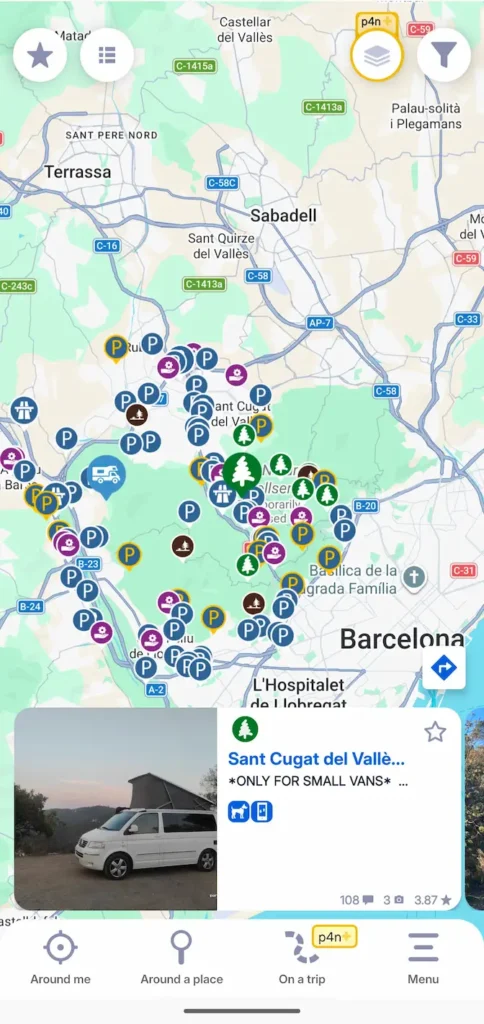
park4night’s community is mostly European – coverage drops quickly outside Europe. In Australia, WikiCamps is the standard – a one-time, cheap purchase, with strong filters. In New Zealand, it’s CamperMate, which is free.
Legality
Is it legal to sleep in a rental car? Yes, in most cases. It depends on the country, but the general rule is simple: it’s fine if you’re legally parked and not displaying “camping behavior” – no chairs or tables outside the car. In some places, that turns parking into camping and makes it illegal. Spain and Norway are good examples of this distinction. Camping behavior also attracts attention. Respect local signs prohibiting overnight parking, keep noise down, leave no rubbish.
Country by country, with fines and where I slept: Is It Legal to Sleep in a Rental Car in Europe?
A handful of places go further and restrict sleeping in the car itself (camping behavior or not). Croatia bans wild camping outside paid campsites, and some municipalities fine from €130 on the spot. Hawaii, dealing with overtourism, bans it outright between 6 pm and 6 am on public property.
Australia has lots of different rules. Most rest areas and regional towns treat it as completely normal – it’s even encouraged to combat driver fatigue. But some well-known tourist hotspots (like Byron Bay) ban sleeping in a car outright, with rangers patrolling daily. Queensland goes even further – state and local laws treat sleeping in a vehicle as camping by definition, so in places like Brisbane, the Gold Coast, and the Sunshine Coast, it’s illegal even with zero camping behavior. I spent a full year car-sleeping around Australia and relied on the WikiCamps app to find legal spots.
New Zealand adds a different aspect: most freedom camping sites now legally require a self-contained vehicle – meaning a fixed toilet and a green compliance warrant (the law changed in 2026) – which a standard rental car won’t have. That limits you to DOC campsites, holiday parks, and the limited number of council areas that still allow non-self-contained vehicles. I spent a few months car-sleeping there too.
The US sits in a similar gray zone – no federal rule, and it comes down to the state and city you’re in. I haven’t covered it myself, so I’ll leave that one alone for now.
A warning for every destination: Be incredibly careful about sleeping in your vehicle after drinking. In many jurisdictions around the world, police treat this as being in control of a vehicle while intoxicated, even if the engine is cold, the keys are out of the ignition, and you are asleep in the back. One possible exception is traveling with a sober, licensed driver who has possession of the keys. Otherwise, if you’re alone or nobody is sober, local camping bylaws are no longer the issue – you could be risking a DUI charge.
Do Rental Companies Allow Sleeping in the Car?
Usually, they don’t say anything. Rental contracts are long, sometimes only in the local language. Before you sign, you can paste the contract into ChatGPT (or any other AI) and ask it to search for any restrictions.
For what it’s worth, Hertz UK’s terms (read in 2026) ban things like off-roading, towing, and driving people for money – sleeping in the vehicle isn’t on that list. Most rentals have GPS, but nobody has ever asked me where I slept. The GPS is generally only checked for reasons like theft, an accident, or a dispute. The bigger risk is returning the car dirty or smelling bad enough to trigger a cleaning fee.
When you pick up the car, they might want your accommodation details for their records. If my first night is a hostel or Airbnb, I use that. They never ask for a full itinerary.
Season
Sleeping in rental cars works best in mild conditions. I prefer nights between 10–20°C (50–68°F). Spring and autumn are the sweet spot in most destinations.
In summer, heat is the limiting factor. Night temperatures above 25°C (77°F) are too much for me – I sweat and struggle. I need airflow and switch to tent camping then.
Winter nights can be cozy at 5°C (40°F) with a proper sleeping bag. Below that, it’s still doable, but starts to become a challenge.
Low season is best: fewer people, lower prices, easier parking.
My Sleeping Setup
Full kit, with weights and prices, built to fly carry-on: Sleeping in a Rental Car Packing List.
Flat Surface
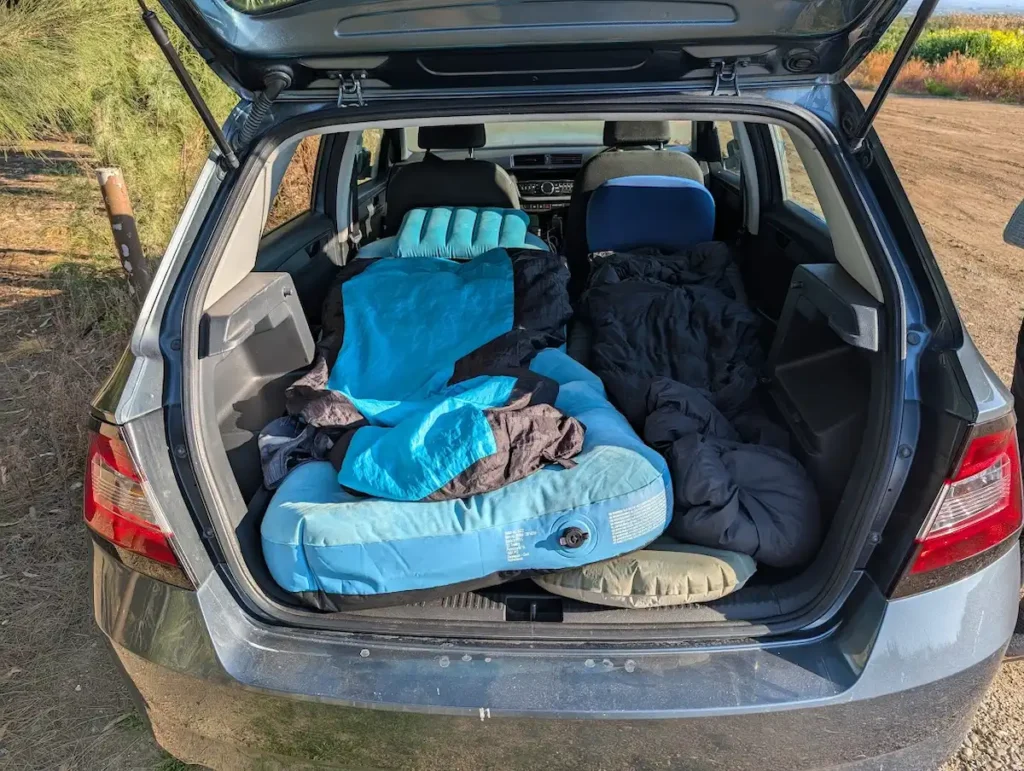
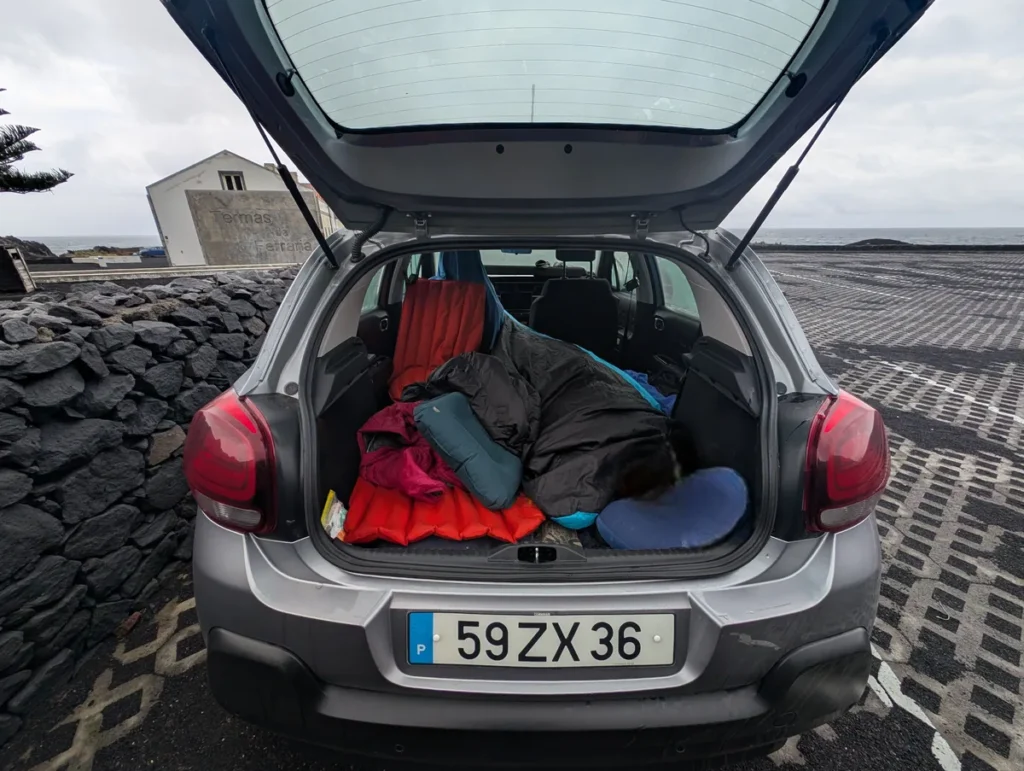
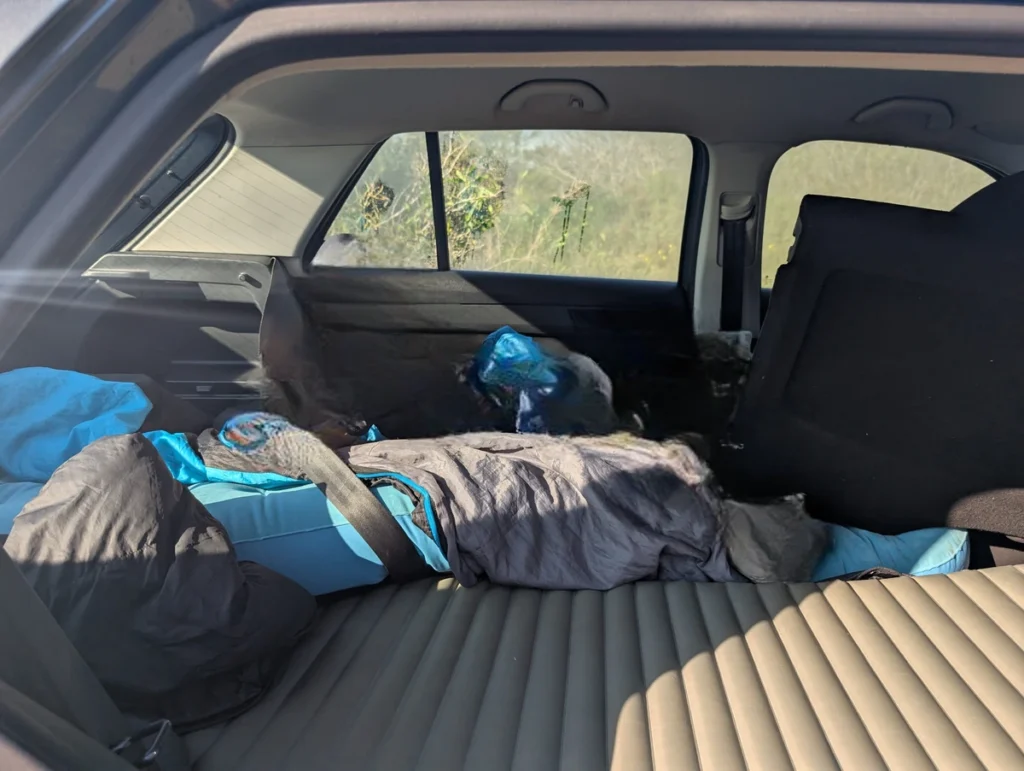
In a rental, I fold down the rear seats and sleep on an inflatable mat with a warm sleeping bag. The most important comfort factor is a flat surface. The two biggest potential issues are:
- The step between the folded seats and the trunk
- Rear seats that don’t fold completely flat
I level things out with whatever I have – clothes or bags under the mat. If there’s more to level out, I pick up sturdy cardboard boxes that supermarkets throw away anyway.
Of all the gear, the inflatable mat matters most – I use the Therm-a-Rest NeoAir XLite. It’s thick enough to smooth out small imperfections, so even imperfect setups become comfortable.
Space and Length
If you’re taller, sleep diagonally from the front passenger seat to the rear corner. This gives an extra 10–20 cm of space.
There’s usually enough gap between the front seats to push the end of the mat through, reclaiming that space as extra length.
Ventilation and Privacy
Always crack two windows slightly (just a few millimeters on cold days), on opposite sides. The airflow clears fogging far better than a single gap – without it, the glass fogs up quickly, making it obvious someone is inside and annoying to wipe clear in the morning before driving. Avoid leaving wet gear (swimwear, towels) inside the car overnight if you can – it increases interior humidity and makes the fogging worse.
In many warmer countries, cracked windows can mean mosquitoes. To keep them out without giving up the airflow, and for extra privacy, I use cheap, dark, lightweight window covers such as these from a general store.
Staying Warm
If it’s cold outside, heat up the car on your way to the overnight spot. Once parked, avoid opening the doors again – if possible, set everything up from inside to keep the heat you’ve built up. Never run the engine overnight to stay warm. It burns fuel for nothing and carries a real carbon monoxide risk. A good sleeping bag is the best way to keep warm.
Charging
On trips with short driving days or long stretches without access to power, keeping devices charged takes some planning. I usually travel with a compact 10,000mAh power bank.
To take advantage of your phone’s fast charging, you need two things: a fast cable and a fast port. Newer rentals come equipped with USB-A or USB-C ports, though not always fast ones. I always carry a USB car charger with at least two fast-charging ports and a couple of matching cables.
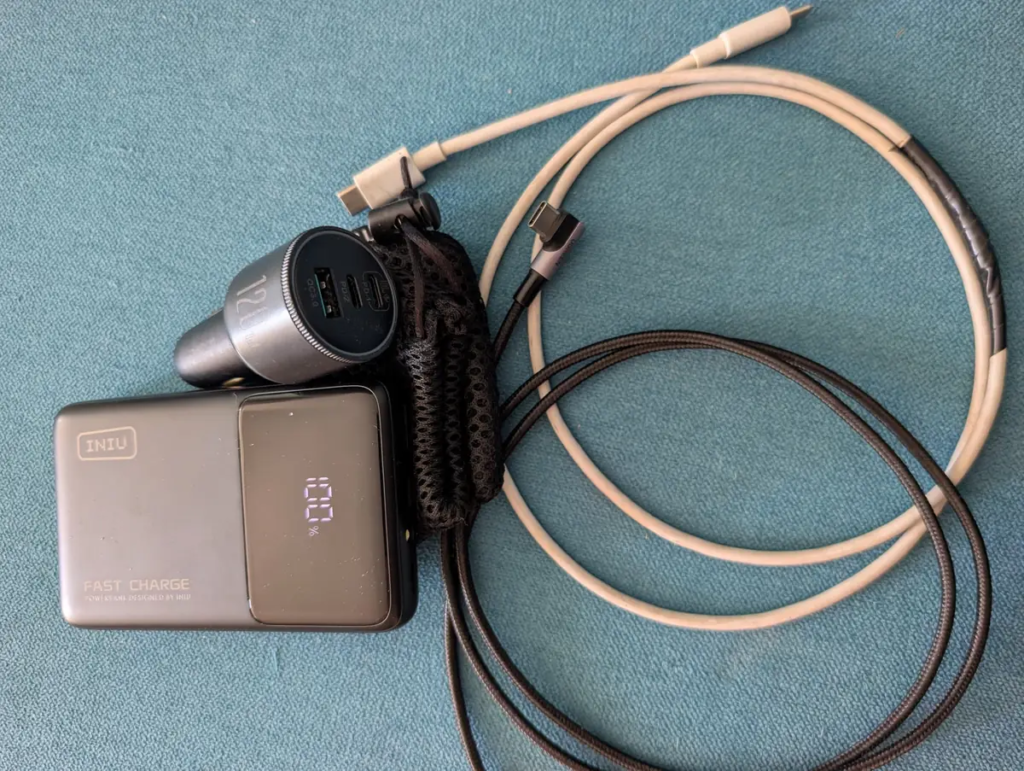
Some cars keep the power socket live even with the engine off – but I’d never charge devices overnight unless I really trust the car. Not worth the risk – you never know how weak a rental’s battery is, and it might not start in the morning.
Best Cars
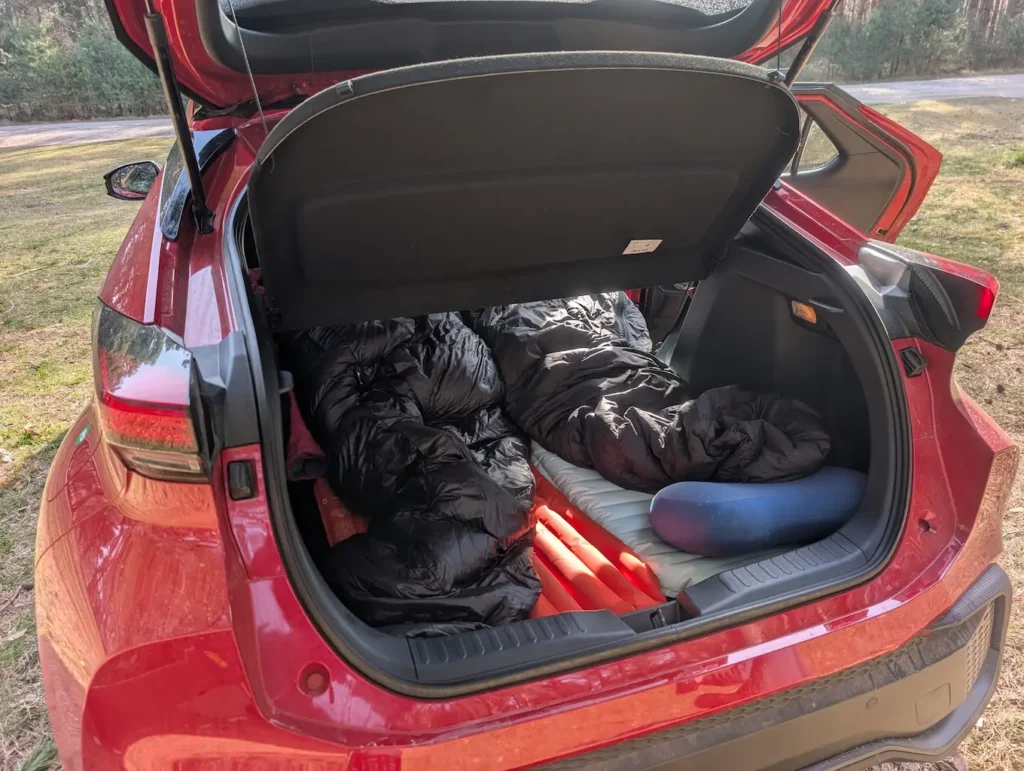
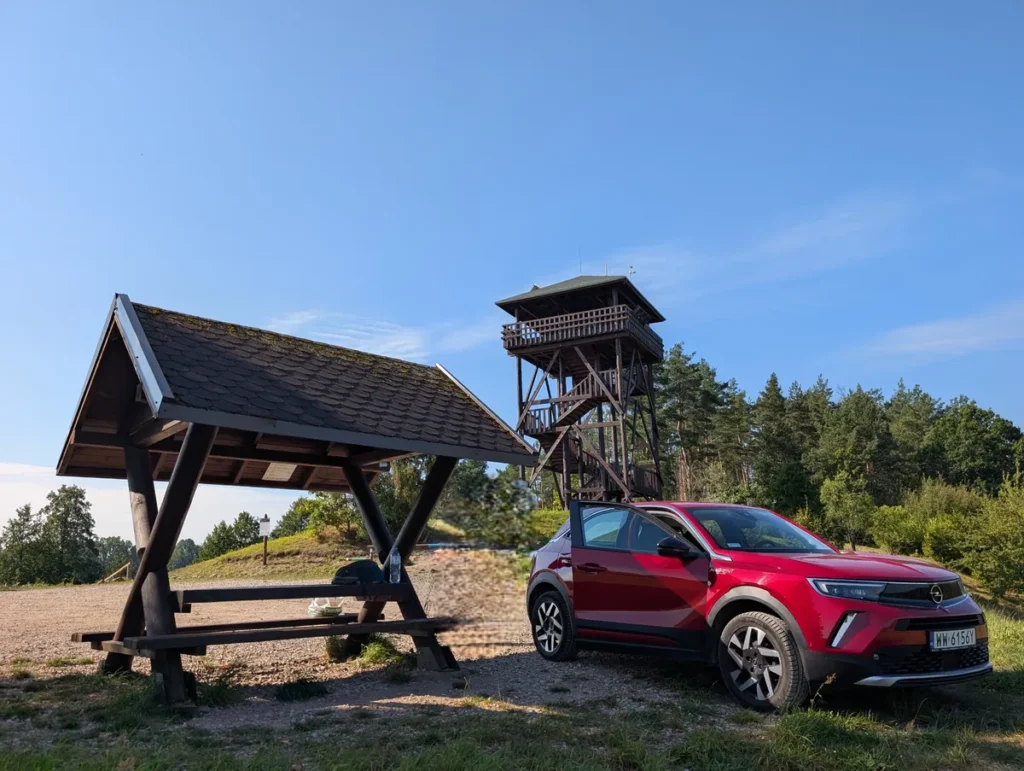
When booking a rental, you’re choosing a class and won’t be guaranteed a specific model – that’s how the industry works. Go for Economy – one step up from the smallest: Renault Clio, Citroën C3, Toyota Aygo X, Škoda Fabia. I’ve booked this class on around 10 trips and always slept well. Compact/Crossover can work too – I’ve used it on three trips. The Mokka was excellent, the C-HR needed a setup, and the Zeekr X was tight for two.
Avoid Mini class – too small. Avoid anything bigger than Compact – bigger doesn’t mean better for sleeping, and it will burn more fuel. Ford Tourneo in Sicily was the worst car I’ve slept in.
Search cheap rentals on DiscoverCars (my review). For first-person sleeping audits on around 15 cars: Best Rental Cars to Sleep In.
For the full process of getting the cheapest rate: €3/Day Rental Car Guide.
Safety
I’ve never had an issue. A few habits that help: arrive late, leave early, avoid dodgy areas. Read the comments on park4night before committing to a spot – other users might mention something was sketchy.
Park facing out, keep driver’s seat empty. If something feels off, you want to be able to leave in 30 seconds.
Always lock from the inside when ready to sleep. If locking with the key triggers the alarm, use the lock button next to the driver’s seat instead. I figured it out on my Poland trip after the alarm went off every time I pressed the key button from inside the car.
Hygiene
Toilets – some public campsites have them, most don’t. Park4night shows a toilet icon when one’s available. Organic Maps app (based on crowd-sourced OSM) lists most public toilets, Google Maps misses many of them. In some countries there is plenty of public infrastructure (Switzerland), in others barely any (Italy).
Showers are harder: public pools, truck stops, beach showers. In southern Spain I used beach showers most days – soap wasn’t allowed, but it was good enough. Park4night and Organic Maps list shower spots too. I don’t shower every day on trips like these. Wet wipes help.
Food
A car means access to larger supermarkets – Lidl, Aldi. It often halves grocery costs compared to convenience stores.
A car means access to larger supermarkets – Lidl, Aldi. It often halves grocery costs compared to convenience stores.
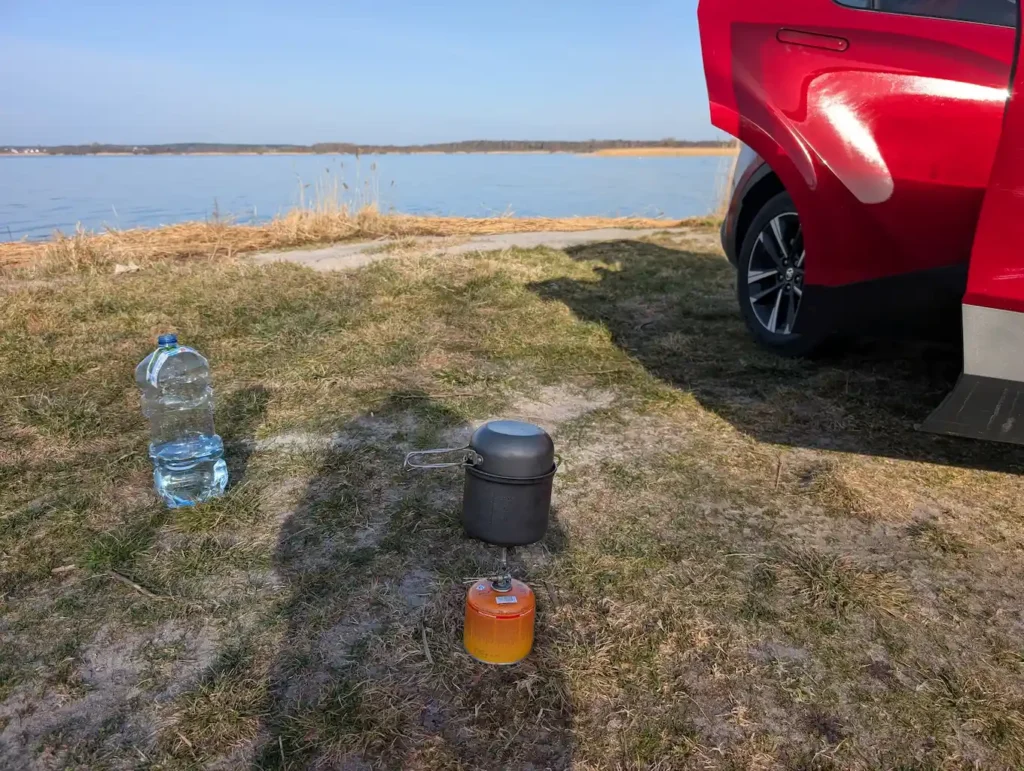
I usually pick up a 5L water bottle (or two) and refill it at public fountains with potable water. Check Organic Maps for drinking water sources.
Cooking
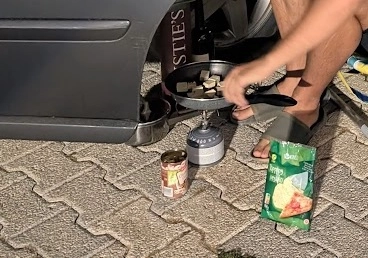
I use a SOTO WindMaster stove, small pot, threaded gas canister (EN 417). Minimal setup that’s easy to pack in a small carry-on or hiking backpack. You cannot take gas canisters on planes – you have to pick one up when you land. Hardware (Leroy Merlin), outdoor sports shops (Decathlon) or large supermarkets (Walmart) usually stock them.
Check local regulations on open flames – fire bans apply in some areas, especially in the summer.
Visiting Cities
For busy cities, I park outside the center – search for free parking on Google Maps and check its reviews for safety. If the center is not within walking distance, I use public transit.
If leaving the car overnight to sleep in a hostel, street parking can be a safer option than parking lots – use Street View to check for good neighborhoods.
Tips Summary
- Spots: Use park4night in Europe. Filter above 4/5, at least a couple of reviews. WikiCamps in Australia, CamperMate in New Zealand.
- Legality: Generally fine. Check and respect local regulations. Country by country: Is It Legal to Sleep in a Rental Car in Europe?
- No Camping Behavior: No chairs or tables outside the car.
- Drinking: Be careful sleeping in the car after drinking. Some places can still charge you with being in control of a vehicle while intoxicated, even with the engine off.
- Rental Contract: Paste it into ChatGPT and ask it to flag overnight restrictions. Contracts usually don’t mention sleeping in the car. Return the car clean.
- Season: Spring and autumn best for most places. Avoid peak summer heat.
- Mat: A good mat in a bad car beats no mat in a good car.
- Surface: Use clothes, bags or cardboard boxes to level out uneven sleeping surfaces.
- Length: Push the end of the mat between the front seats for extra space.
- Ventilation: Crack two windows on opposite sides. Keep wet gear out of the car overnight.
- Bugs: Dark, lightweight window covers keep mosquitoes out and add privacy.
- Staying Warm: Never run the engine overnight – carbon monoxide risk. Get a good sleeping bag.
- Charging: Bring a fast USB car charger with matching cables. Don’t charge overnight – carry a power bank instead.
- Gear: 3.8kg carry-on kit with every weight and price: Sleeping in a Rental Car Packing List.
- Car Class: Economy. Avoid Mini and anything bigger than Compact.
- Safety: Arrive late, leave early. Be ready to drive away. Lock from inside.
- Hygiene: Park4night and Organic Maps for toilets and showers. Carry wet wipes.
- Food: Large supermarkets. 5L water bottle, refill at public fountains.
- Cooking: You can’t take gas canisters on planes – buy one on arrival. Check for local fire bans.
- Cities: Park outside the center, use public transit to get in.
- Rates: European Car Rental Price Comparison – price table updated regularly.
- Costs: Budget Travel Cost per Day – what all of my trips cost per person per day.
- More Tricks: Budget Travel Tips – flights, hostels, sights and food.