Andalusia – Seville, Gibraltar on €16/Day: Sleeping in a Car
Seville (Alcázar and cathedral), Cádiz, Gibraltar. 5 days in Andalusia sleeping in a car – add €6/day to the number if renting:
TRIP STATS
- DAILY RATE: €16.38 (per person)
- SLEEP: Sleeping in Car
- BY: Car
- PEOPLE: 2
- DAYS: 5
- TOTAL: €163.80
- CURRENCY: Euro (€)
- DATE: October 2025
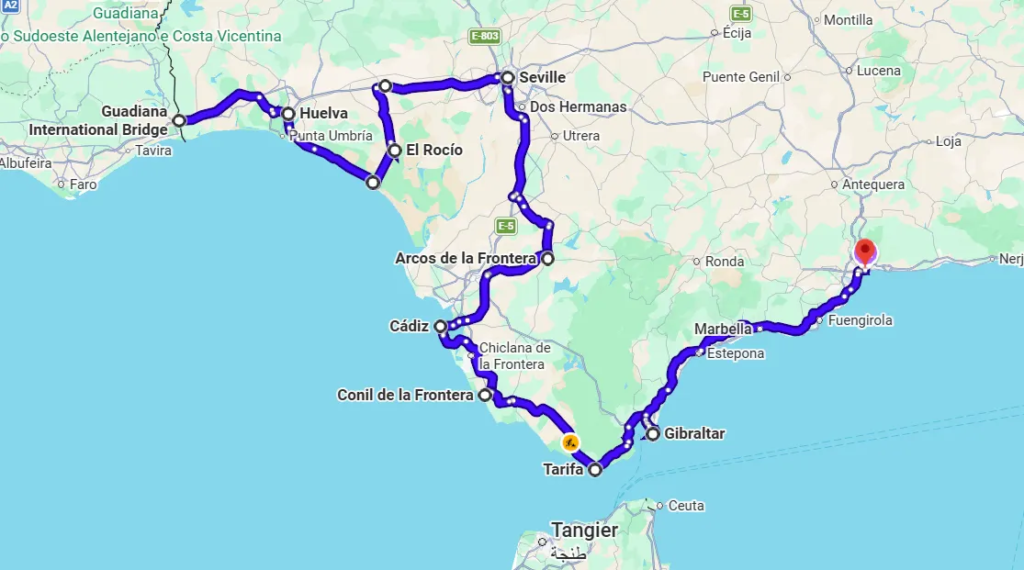
- ROUTE: Portugal → Huelva → Seville → Cádiz → Gibraltar → Málaga
- TOOLS: DiscoverCars, park4night, Revolut, Lidl

| ITEM | COST (2P) | NOTES |
|---|---|---|
| Stay | €0.00 | Slept in the car. |
| Fuel | €40.00 | €8.00/day. |
| Food | €62.00 | €6.20/day per person. Shopped at Lidl. |
| Sights | €61.80 | Per person: €15.50 – Alcázar of Seville €13 – Seville, Cathedral €2.40 – Gibraltar bus |
| TOTAL | €163.80 | 5 days at €16.38/day per person |
Getting There
We drove into Andalusia from Portugal (starting in Lisbon) and then carried on east towards the rest of Andalusia, Catalonia and eventually to France.
If you’re flying in, Seville is the cheapest entry point, served by Ryanair, Wizz Air and easyJet. If you’re flying with a small carry-on and are flexible with your dates, there are deals under €20 on Skyscanner for Morocco, France, Poland, Portugal, the UK, Italy and more.
Car Rental at Seville Airport
We did this trip in our own car, so I can’t comment on rental providers. If you’re flying into Spain, these are the current prices and things worth knowing:

- Current Prices: Small cars in Seville from €43/week (€6.14/day) at the time of writing via DiscoverCars (my review). Full European rental comparison.
- Excess: Decline the desk insurance. Cover it with an independent policy like Cover4Rentals instead: €3/Day Rental Car Guide.
- Tolls: We stuck to free roads throughout – the right call for sightseeing. Most of the roads in Spain are free with a few exceptions. In the area covered in this post the only paid segment is Gibraltar to Málaga, but we took the free alternative.
- Fuel: Diesel was as low as €1.20/L during our October 2025 trip, although prices fluctuate. Spain’s fuel is much cheaper than Portugal (€1.55/L in the same month) and consistently one of the cheapest in the EU. Unstaffed stations (like Plenoil or Ballenoil) offer significantly cheaper fuel than the big brands like BP and Shell. Google Maps didn’t show real-time fuel prices in Spain reliably for us. We used Gasall app.
- Parking: We always managed to find free parking using Google Maps search. In big cities like Seville we had to walk quite a bit from the parking spot, but it was manageable. Curb lines are color-coded in Spain and mean the following: white – free and unlimited parking, blue – paid parking, green – residents only, yellow – no parking (although you’ll see locals breaking this rule all the time).
Sleeping in a Car in Spain
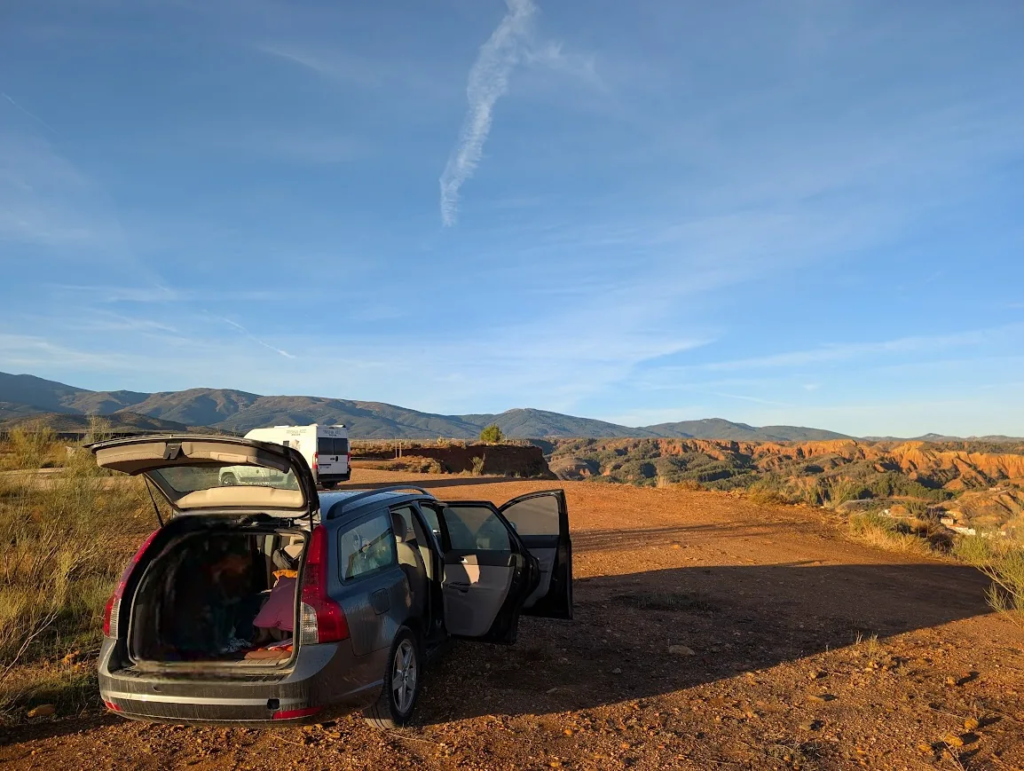
Volvo V50. 4/5. Spacious.
Long car, plenty of room for two. Rear seats folded fully flat – no step. One issue: a fixed metal bar ran the full width at the top of the folded seatback. At 190 cm, it pushed my feet up slightly. An inflatable mat mostly fixed it.
Full sleeping audit: Best Rental Cars to Sleep In.
- Legality: Legal to sleep in your car in Spain as long as you are legally parked and don’t display any “camping” behavior (no tables or chairs outside the car). According to the Spanish Traffic Authority (DGT), you are considered legally parked if all activity stays strictly inside the vehicle. Local bylaws sometimes ban overnight stays, particularly in natural parks and directly on coastal beaches. Full guide: Sleeping in Rental Cars.
- Facilities: Public toilets are sparse and unreliable in Spain. Supermarkets (mainly Lidl) were the most reliable option throughout the route – free toilets, easy to find. Some beaches have outdoor showers.
- Overnight Spots: Search park4night for marked spots. I’ve linked to the spots I stayed at in the Route section below.
- Backup Accommodation: Booking.com has the widest (and usually the cheapest) selection in Spain. Sort by lowest price, filter to 7.0+ to get rid of bad listings.
Food
€62 for two people over 5 days. €6.20/day per person.
We shopped at Lidl – consistently the cheapest supermarket option across Europe. When there isn’t one nearby, Aldi is the next best alternative in Spain. Mercadona is slightly more expensive but sometimes the only option. We also shopped at Alcampo and Carrefour a couple of times for more variety, although prices were higher.
We cooked dinners and coffee on a gas stove. In Andalusia, outdoor cooking is banned in or near forested areas from June 1 to October 15 – our trip was just after this period. Never use a stove near rural areas, forests, or protected zones during this time. Check current fire risk before cooking outdoors: aemet.es.
Route
We crossed from Portugal on the Guadiana International Bridge in the late afternoon and headed straight to Huelva, the first city across the border. It’s not a very interesting city, but it was getting late, so we found a parking lot next to a park with public toilets and spent the night there. It was in a quiet part of the city. We put up curtains, cracked the windows, and didn’t draw any attention. Peaceful night. Not far from us was the restored pier of Muelle de Riotinto with plenty of locals hanging out.
Day 1 – Doñana National Park, El Rocío, Seville
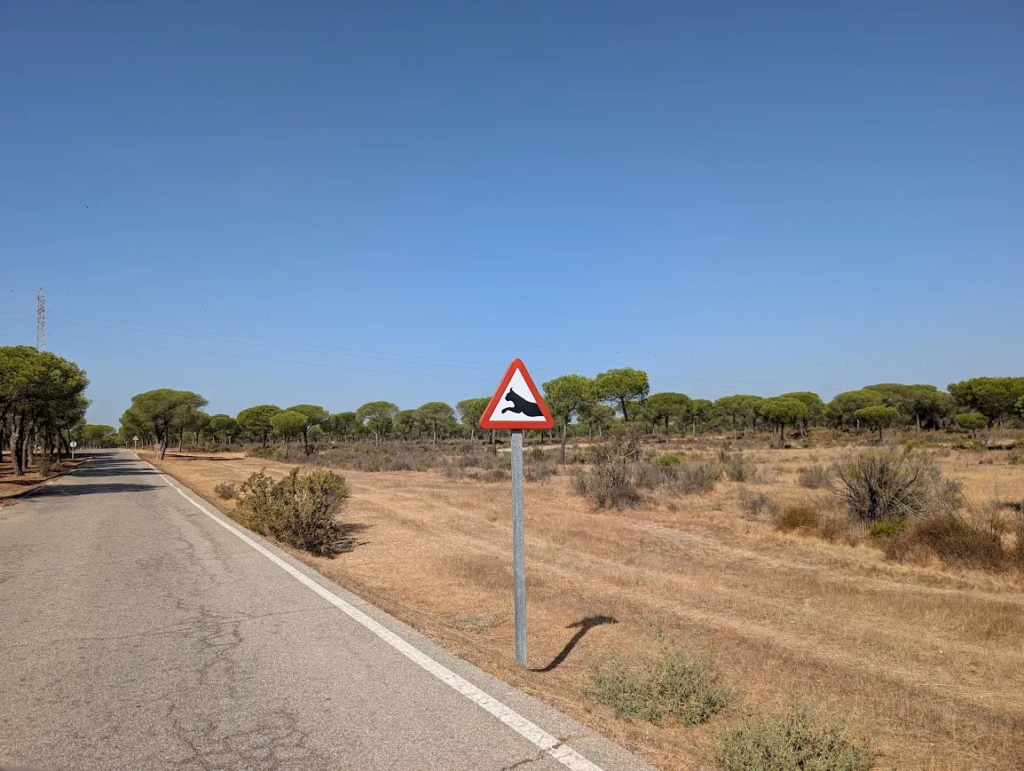
We woke up, shopped at Huelva’s Lidl (had to wait a bit as supermarkets in Spain don’t open until 9am) and headed along the coast to Doñana National Park, known for its wetlands, dunes, migratory birds and an elusive lynx.

Our main draw was the lynx, so we hiked a bit from the visitor center, but didn’t manage to see any – it’s very rare. You can head on a tour to increase your chances of seeing one.
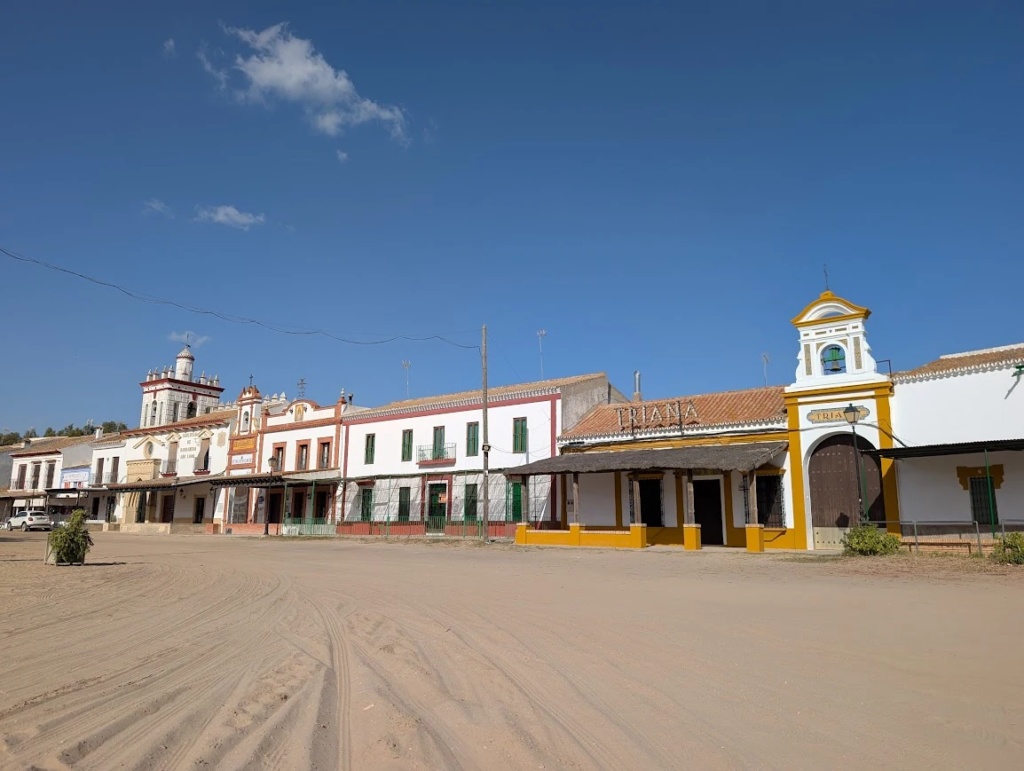
After Doñana, we started heading north and, without planning it, stopped at El Rocío – a very unusual pilgrimage site. All the roads within town are dirt roads, it has a bit of a Wild West feel. After seeing the main sanctuary, we drove around a bit and actually got stuck in the sand while driving a little off the main tracks to get a good angle for a picture. Our car wasn’t made for this. Fortunately it only took a little bit of digging in front of the wheels with our hands and a gentle push to get it out.
In the evening we arrived in Seville and had our first glimpse of the city. We checked out the Seville Museum of Fine Arts (open until 9pm, closed Mondays). Free for EU citizens, otherwise €1.50. We spent about an hour – pleasant, but not particularly memorable. We hadn’t heard of any of its paintings before.
We headed back to our car (about a 30-minute walk on the other side of the canal) and looked for a sleeping spot. We decided on a parking lot next to Camas shopping center with a Carrefour. The toilets were still open after the shop closed at 10pm. Peaceful night, nobody bothered us – although when we woke up there were a lot of construction workers parked around us, slightly awkward.
Day 2 – Seville
This day we dedicated fully to exploring Seville. Usually, when we’re visiting a city of this calibre, we get a night in a hostel to enjoy it fully – it makes the city experience easier – but our trip had just started and we felt like doing Seville car-based.
In the morning, we parked the car about a 40-minute walk from the center and headed in.
Catedral de Sevilla and La Giralda
Our first major sightseeing spot was the massive Catedral de Sevilla, the largest Gothic cathedral in the world. The tickets on the official website were sold out and the ticket office queue was massive, but we followed a trick we’d looked up beforehand – we went first to the Church of San Salvador (included in the cathedral ticket) and purchased our tickets there without any wait. After seeing that one, we headed to the cathedral and were allowed to skip the queue entirely, saving us so much time.

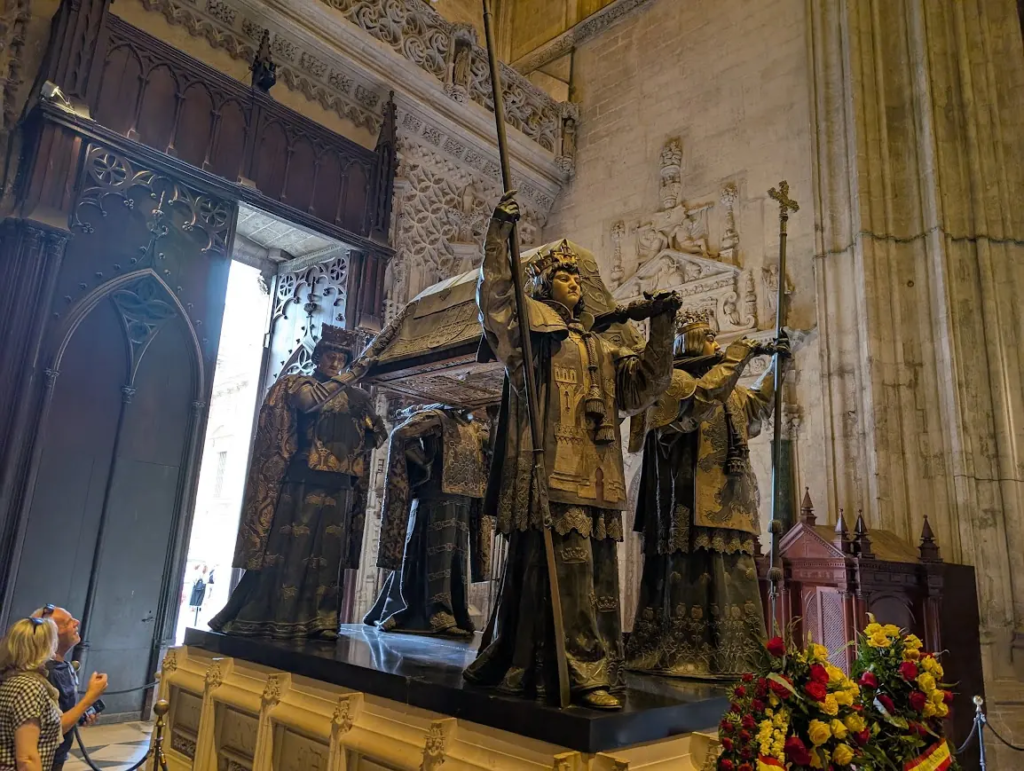
The cathedral was exceptionally big and memorable, it didn’t disappoint. Inside is the tomb of Christopher Columbus. You can also climb La Giralda, the bell tower with views over the city, originally built in the 12th century as a minaret. It took about 10–15 minutes to climb as there are a lot of stairs and it’s full of people of all ages – you have to walk at the pace of the slowest person.
Royal Alcázar of Seville
Afterwards – Royal Alcázar of Seville. I had managed to grab tickets a day before on the official website. They were all sold out, but I kept checking periodically and at some point a few next-day tickets appeared, which I immediately booked.

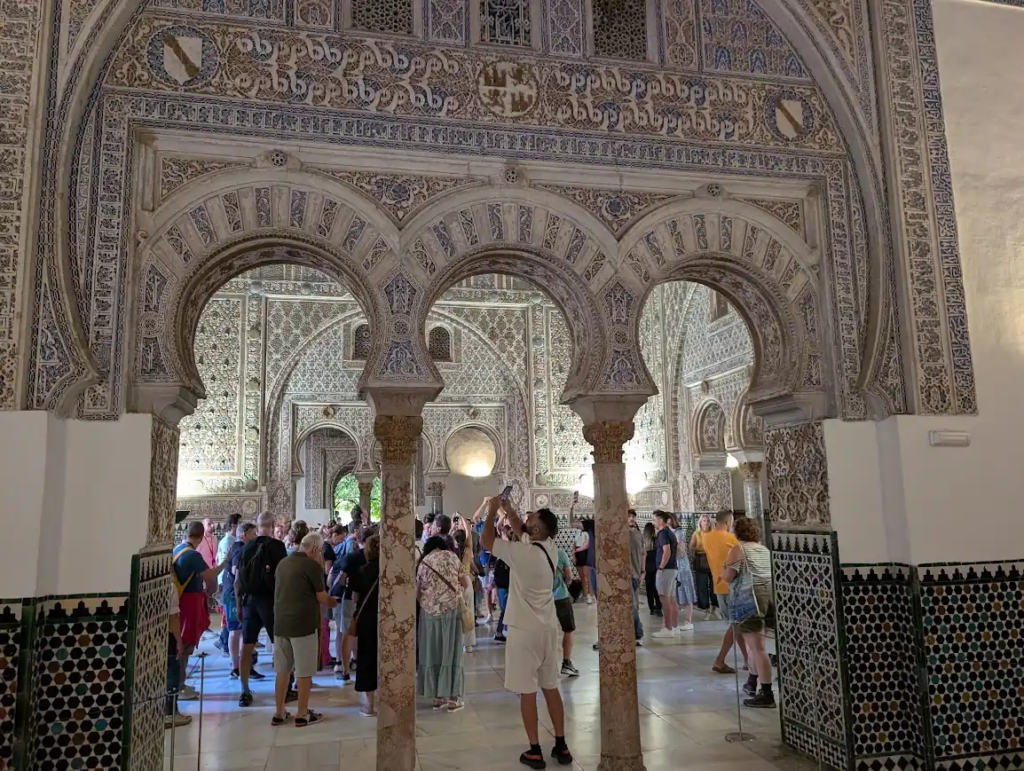
The Alcázar is the landmark of Seville and absolutely worth it. It blends Islamic (Mudéjar) architecture with Christian Gothic, resulting in a very unique mix. It’s not that big – we spent about 2 hours inside, taking it slowly. They provide an audioguide – you have to download the app, the history is super interesting.
After leaving we passed by Torre del Oro – technically free, but they ask for a small donation. We skipped it as the reviews didn’t seem that interesting. Then we headed to Plaza de España.
Plaza de España
Plaza de España was an absolutely beautiful landmark, one of the most expansive plazas in Spain. It features a colorful series of 48 tiled benches, each representing a Spanish province with its map and historic scenes. So much art. It was built in 1928 for an exposition. There are also canals, bridges, fountains and people dancing flamenco in the middle. You can see it for free, although as with all street performers, if you like it, leave a €1–2 coin. It was our first introduction to flamenco, absolutely wonderful.

We walked some more, passed by the well-known Setas de Sevilla, but we didn’t find them interesting enough to pay the €15 entry fee. In the evening we had some cheap dinner, headed back to the car and slept at the same parking lot. Another peaceful night.

We felt like we’d seen most of Seville in that 1.5 days. In hindsight, another day would’ve been nice to relax and take in the ambience, but we had already made plans to carry on.
Day 3 – Cádiz, Conil de la Frontera
In the morning we started heading south. We passed Arcos de la Frontera but skipped the hilly center due to traffic restrictions. Instead, we stopped at nearby viewpoints to see the town and the castle on top.
Our main stop of the day was Cádiz. Parking is tricky, but we found a cheap spot for just a few euros – space is really sparse as it’s a peninsula connected to the mainland by a narrow spit.
We spent about 3 hours in Cádiz, walking around the old town and its coast. We saw the cathedral only from the outside – a beautiful sight – but we decided the €9 ticket didn’t justify visiting another cathedral. We found Cádiz beautiful but a bit underwhelming right after Seville. It’s an ancient city, yet its streets didn’t feel as old as the ones in Seville – to us, at least.
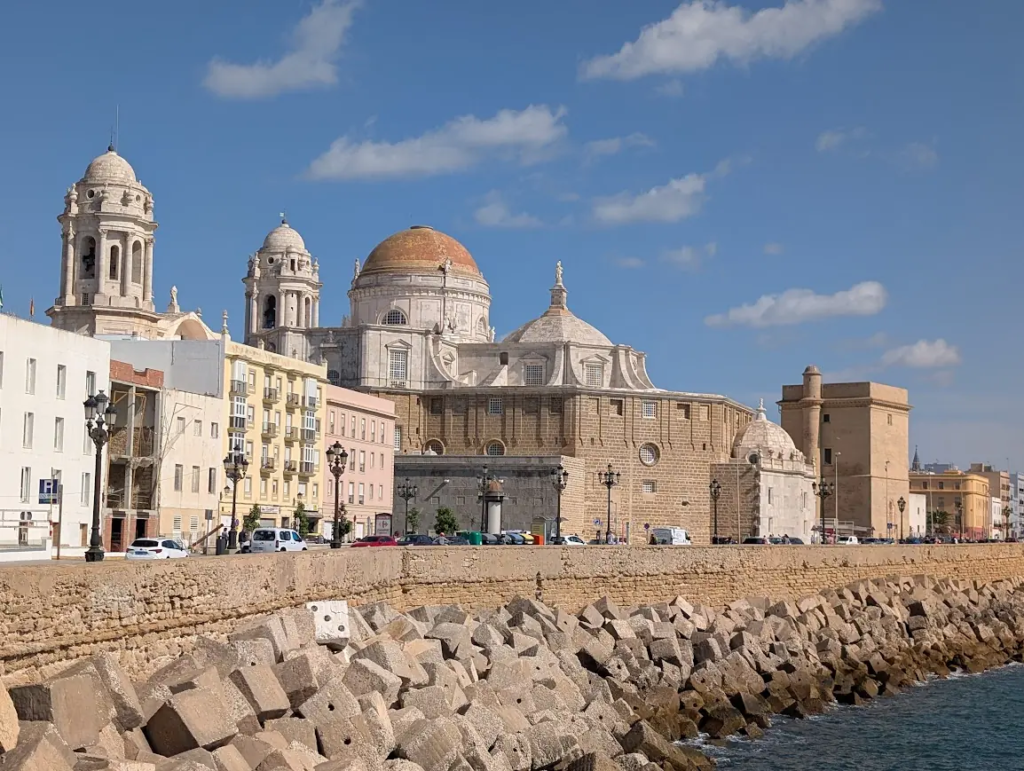
In the afternoon we started driving east towards Gibraltar. We wanted to find a local flamenco bar – not one mainly oriented towards tourists – and eyed one in Conil de la Frontera. Unfortunately it turned out that night wasn’t a flamenco night there. Still, the town was interesting, much less touristic than Seville and Cádiz and still beautiful.
In the evening we drove out and slept at a pullover next to a quiet road by the river just outside town. Very peaceful night.
Day 4 – Baelo Claudia, Tarifa, Gibraltar
Our first stop was Baelo Claudia, well-preserved Roman ruins (only open until 3:00PM, depending on the season). Entry is free for EU citizens and €1.50 for others. We used the provided audioguide.

Next we stopped in Tarifa, the customary border between the Atlantic Ocean and the Mediterranean Sea. It was super windy – we were told it’s always like this. You can walk the spit that supposedly separates the two bodies of water. There were kitesurfers pulling off absolutely crazy jumps (around 10 meters up into the air) and we spent a good half an hour watching them. We also headed into the old town for a short walk. Pretty, but by this point Andalusian old towns were starting to feel repetitive.
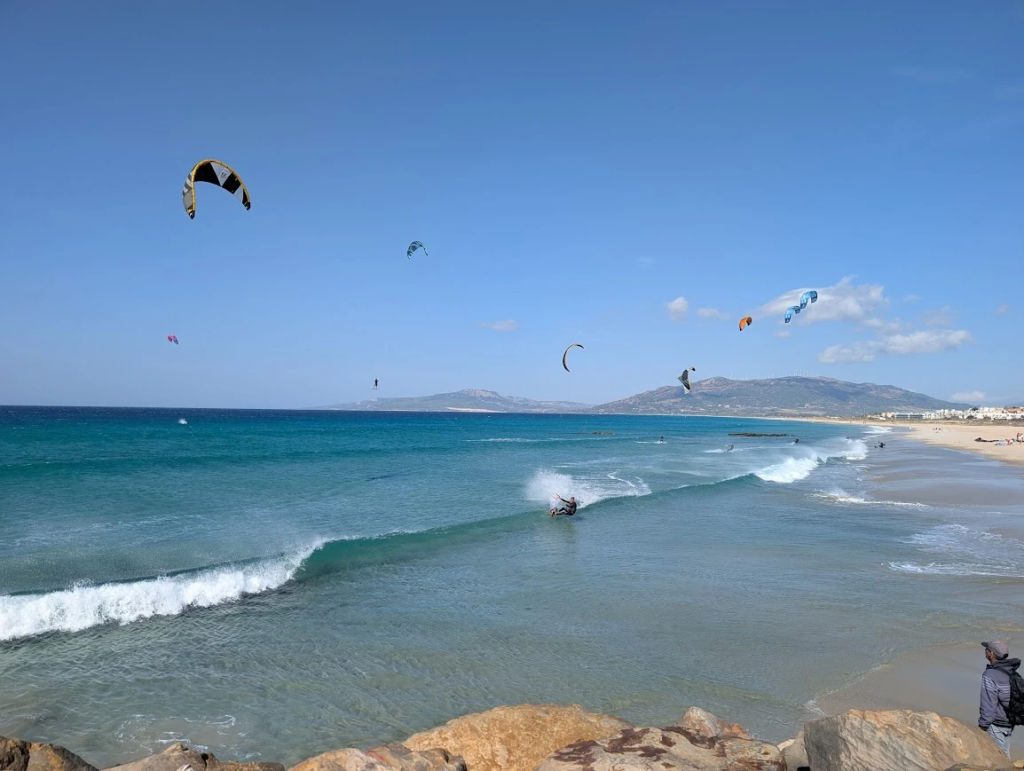
On we went towards Gibraltar. We stopped at Mirador del Estrecho, a popular viewpoint from where you can see Morocco – just 15km away across the strait. There was heavy traffic on the road and we got slowed down.
Around 3PM we arrived close to the Gibraltar border. We decided not to take our car over due to very limited and expensive parking and big queues at the border. We parked for free around a 10-minute walk from the crossing and walked over on foot. We showed our EU IDs but the officers didn’t look at them at all and just waved us through.
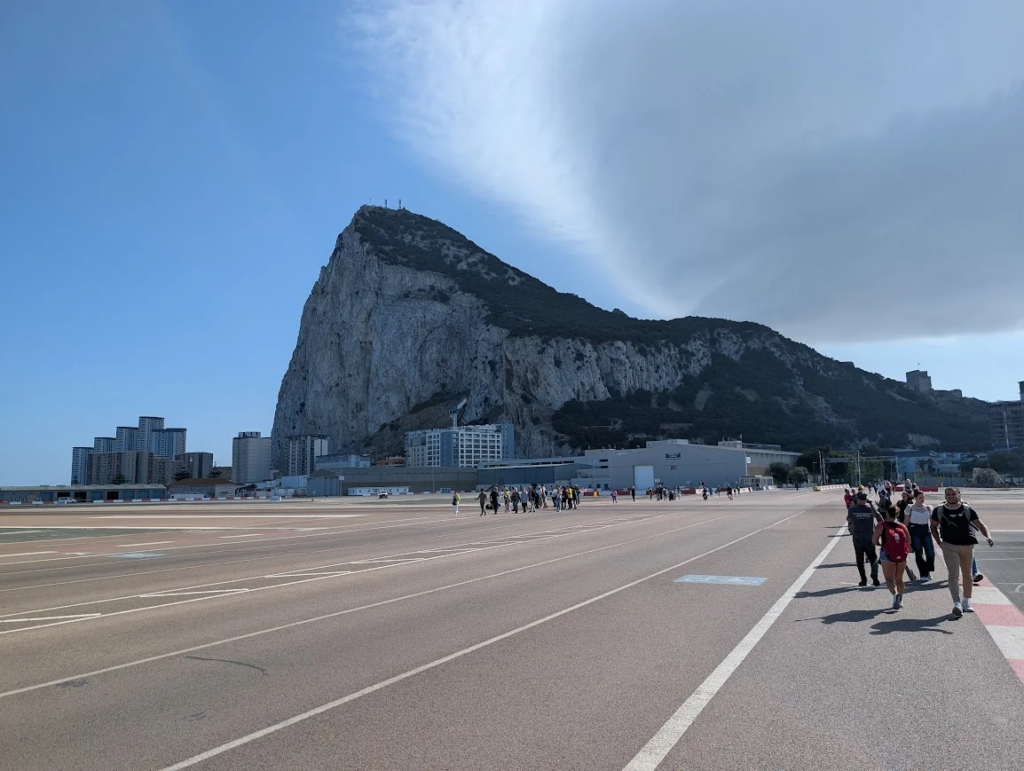
We took the bus to Europa Point Lighthouse for £1.80/€2.40 – no card accepted, but you can pay in euro coins. We decided to pay one way and hike back to sightsee. In hindsight the walk back wasn’t that interesting and we should have paid for a return ticket from the start – return is only £2.40/€3.50.
Europa Point Lighthouse is a beautiful viewpoint and again, you can see Africa. There’s a mosque nearby due to a large population of workers from Morocco. We took about an hour to walk back to the town center. Gibraltar features an interesting mix of British and Spanish culture, visible in the architecture. There are plenty of information boards with its history, which we studied thoroughly and found super interesting. Apart from that, there aren’t really any major tourist attractions – the main street is full of shops, not our cup of tea. You can go up to see the monkeys on the Rock of Gibraltar, but it costs £30, plus £19.50 if you want the cable car. We had seen plenty of monkeys before and didn’t find it worth the money.
After heading back to the Spanish side, we again tried to find a bar with flamenco. We went to Peña Flamenca Cultural Linense. They didn’t have anything going on that night, but we still ordered a beer, started talking and made a couple of local friends in our broken Spanish. It turned out they were flamenco artists themselves – they took us to another room and sang a few songs for us. Such a special experience.
At night we drove to Pueblo Nuevo and slept close to a park and river. Very peaceful, again. Spain so far had given us the feel of an extremely safe place.
Day 5 – Towards Málaga
We took this day very easy. Covered quite a bit of ground driving-wise – relaxed on the beach, took a couple of swims, went for a short hike.

In the evening we passed by Colomares Castle (already closed, we saw it through the fence) and reached Málaga, where we parked overnight right next to the beach in a spot with plenty of other caravans – around 20 or so – which made us feel extra safe and legitimate.
Season
End of October was a great time to visit. It was still very warm – what many Europeans would consider summer weather – but not unbearably hot, as it can be during peak summer months. Andalusia is one of the hottest regions in the country and is prone to wildfires.
October still sees fairly high tourist numbers, especially in bigger cities. For a quieter trip, go in November.
Practical
Currency
Euro. Cards are accepted almost everywhere, but carry some cash for parking attendants or street vendors. If you’re coming from a non-euro country, use Revolut to avoid conversion fees. There’s a 1% weekend markup, but you can avoid it by exchanging currencies in the app beforehand.
SIM
Any EU SIM works under Roam Like at Home – no need to buy a local one. If you don’t have one, check eSIMDB, filter by the amount of data you need and your trip length, then sort by price.
Language
Spanish. English is widely spoken in hospitality and tourism, but not reliably outside of it. Learn at least a few phrases:
- hola – hello
- buenos días – good morning/good day
- buenas tardes – good afternoon
- buenas noches – good evening/good night
- gracias – thank you
- por favor – please
Tips Summary
- Cheapest Rentals: Search via DiscoverCars – Toyota Aygo from €43/week (€6.14/day) at Seville Airport at the time of writing.
- Sleeping in a Car: Legal in Spain as long as you’re legally parked and all activity stays inside the vehicle. No tables or chairs outside. Local bylaws vary – check national parks and coastal areas.
- Cheap Fuel: Use Plenoil or Ballenoil instead of BP or Shell. Diesel was €1.20/L in October 2025. Use the Gasall app – Google Maps doesn’t show real-time fuel prices in Spain reliably.
- Parking in Seville: Free spots exist but expect a 30–40 minute walk to the center. Search Google Maps. Blue curb = paid, white = free, green = residents only, yellow = no parking.
- Seville Cathedral Tickets: Buy at the Church of San Salvador next door – no queue, same ticket, lets you skip the line at the cathedral entrance. Saves 30–60 minutes.
- Alcázar: Sells out days in advance. Keep checking – cancellations appear. Book the moment you see availability.
- Gibraltar on Foot: Skip driving over. Park free on the Spanish side (~10-minute walk) and cross on foot. Buy a return bus ticket to Europa Point from the start – £2.40/€3.50, cheaper than two single tickets.
- Baelo Claudia: Closes at 3:00PM (depending on the season). Free for EU citizens, €1.50 for others.
- Flamenco: Tourist venues are everywhere but finding a local flamenco club takes luck and timing.
- Season: End of October still warm, still busy. November is quieter.
The Budget System
I keep daily travel costs under €20–€30 using two methods:
● €3/Day Rental Car Guide
● Sleeping in Rental Cars
One week of travel cost me less than a day of work in Australia.