Córdoba, Sierra Nevada, Mulhacén on €16/Day: Sleeping in Car
Córdoba (with its Mosque-Cathedral), Jaén, Baeza, Úbeda, and Mulhacén – the tallest mountain in mainland Spain at 3,479 m. 4 days in Andalusia sleeping in a car – add €5/day to the number if renting:
TRIP STATS
- DAILY RATE: €16.25 (per person)
- SLEEP: Sleeping in Car (3 nights), Hostel (1 night)
- BY: Car
- PEOPLE: 2
- DAYS: 4
- TOTAL: €130.00
- CURRENCY: Euro (€)
- DATE: October 2025
- ROUTE: Almodóvar del Río → Córdoba → Jaén → Baeza → Úbeda → Sierra Nevada → Granada
- TOOLS: DiscoverCars, park4night, Revolut, Lidl

| ITEM | COST (2P) | NOTES |
|---|---|---|
| Stay | €29.00 | 3 nights: Slept in the car (€0/night) 1 night: Córdoba room (€29/night) |
| Fuel | €40.00 | €10/day. |
| Food | €61.00 | €7.63/day per person. Shopped at Lidl. |
| Sights | €0.00 | |
| TOTAL | €130.00 | 4 days at €16.25/day per person. |
How €16.25/day per person compares to my other trips: Budget Travel Cost per Day.

Getting There
We drove into Andalusia from Portugal (starting in Lisbon) and carried on east towards Catalonia and eventually France. This was part of our 52-day trip through Spain, Portugal and France.
- Previous leg: Málaga, Ronda & Caminito del Rey on €15/Day: Sleeping in Car
- Next leg: Granada and Almería on €22/Day: Alhambra and Sleeping in Car
- Full trip: Spain, Portugal & France on €19/Day
If you’re flying in for this leg, your entry point would be Granada Airport (GRX) – however it operates almost entirely as a domestic airport. If you’re flexible with dates and travel with a small carry-on, Iberia and Vueling offer €20–€30 flights from Madrid or Barcelona, where you can connect onto Ryanair or Wizz Air internationally for €20 to Italy, the UK, France, Portugal, Germany. These deals are mostly possible with open-date searches on Skyscanner.
Full list of what I pack and more carry-on rules: Sleeping in a Rental Car Packing List.
Car Rental at Granada Airport
We did this trip in our own car, so I can’t comment on rental providers. If you’re flying into Spain, these are the current prices and things worth knowing:

- Current Prices: Small cars in Granada from €33.65/week (€4.81/day) at the time of writing via DiscoverCars (my review). Full European Car Rental Price Comparison.
- Excess: Decline the desk insurance. Cover it with an independent policy like Cover4Rentals instead: €3/Day Rental Car Guide.
- Tolls: We stuck to free roads throughout – the right call for sightseeing. Most of the roads in Spain are free with a few exceptions, none of them around Granada.
- Fuel: Diesel was as low as €1.20/L during our October 2025 trip, although prices fluctuate. Spain’s fuel is much cheaper than Portugal (€1.55/L in the same month) and consistently one of the cheapest in the EU. Unstaffed stations (like Plenoil or Ballenoil) offer significantly cheaper fuel than the big brands like BP and Shell. Google Maps didn’t show real-time fuel prices in Spain reliably for us. We used the Gasall app.
- Parking: We always managed to find free parking using Google Maps search. In cities like Córdoba we had to park further out and walk, but it was manageable. Curb lines are color-coded in Spain and mean the following: white – free and unlimited parking, blue – paid parking, green – residents only, yellow – no parking (although you’ll see locals breaking this rule all the time).
Sleeping in a Car in Spain
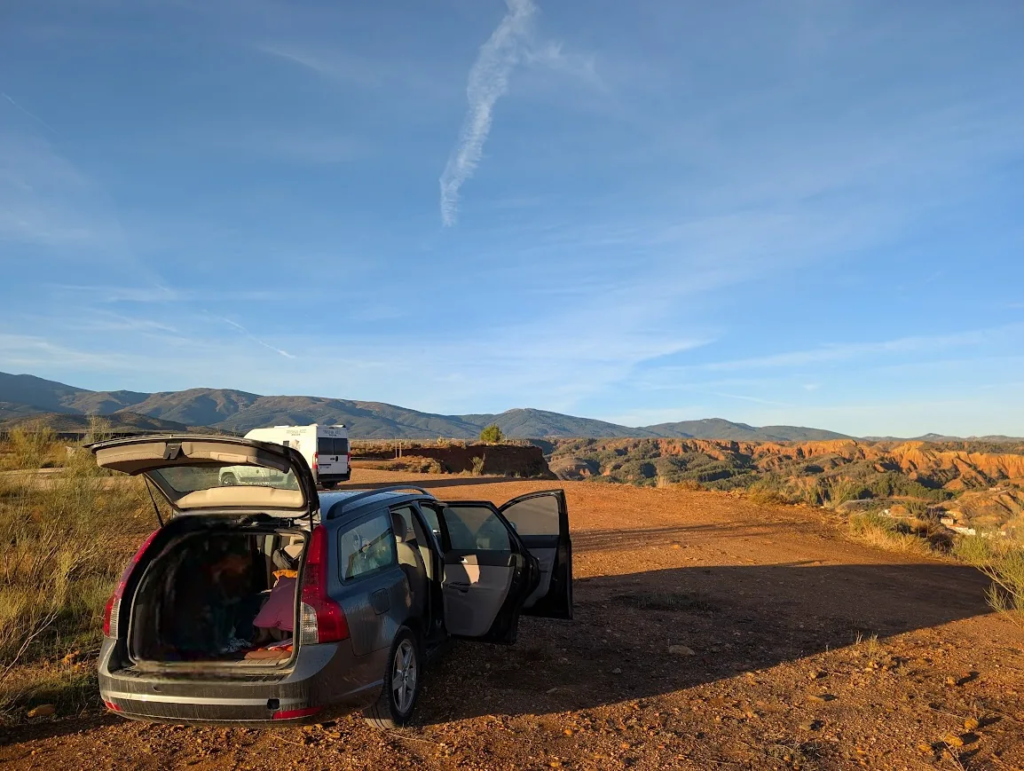
Volvo V50. 4/5. Spacious.
Long car, plenty of room for two. Rear seats folded fully flat – no step. One issue: a fixed metal bar ran the full width at the top of the folded seatback. At 190 cm, the bar pushed my feet up slightly. An inflatable mat mostly fixed it.
Full sleeping audit: Best Rental Cars to Sleep In.
- Legality: Legal to sleep in your car in Spain as long as you are legally parked and don’t display any “camping” behavior (no tables or chairs outside the car). According to the Spanish Traffic Authority (DGT, Instruction PROT 2026/04, March 2026), a correctly parked vehicle counts as parked whether or not people are inside, as long as only the wheels touch the ground, nothing extends past the vehicle and nothing is discharged. Local bylaws sometimes ban overnight stays, particularly in natural parks and on coastal beaches. Country by country: Is It Legal to Sleep in a Rental Car in Europe? Full guide: Sleeping in Rental Cars.
- Facilities: Public toilets are sparse and unreliable in Spain. Supermarkets (mainly Lidl) were the most reliable option throughout the route – free toilets, easy to find.
- Overnight Spots: Search park4night for marked spots. I’ve linked to the spots I stayed at in the Route section below.
- Backup Accommodation: Booking.com has the widest (and usually the cheapest) selection in Spain. Sort by lowest price, filter to 7.0+ to get rid of bad listings. More accommodation tricks: Budget Travel Tips.
Food
€61 for two people over 4 days. €7.63/day per person.
We shopped at Lidl – consistently the cheapest supermarket option across Europe. When there isn’t one nearby, Aldi is the next best alternative in Spain. Mercadona is slightly more expensive but sometimes the only option. We also shopped at Alcampo and Carrefour a couple of times on this trip for more variety, although prices were higher.
In Córdoba we used the hostel kitchen, otherwise we cooked meals and made coffee on a gas stove. In Andalusia, outdoor cooking is banned in or near forested areas from June 1 to October 15 – our trip was just after this period. Be cautious with a stove near rural areas, forests, or protected zones. Check current fire risk before cooking outdoors: aemet.es.
Route
Day 1 – Almodóvar del Río, Córdoba
After driving over from the Malaga area (Ronda, Caminito del Rey, Antequera), our first stop was the castle of Almodóvar del Río. It’s very picturesque and was featured in Game of Thrones. It turned out to be closed for lunch when we arrived, but anyway when it comes to sights like this we’re often more interested in getting nice views of them from the outside, not so much the interior, which can get repetitive, unless the exhibition is really good. We also drove up to the castle – many people seemed not to realize you can do that and parked at the lower lot instead. It wasn’t busy during lunch hours, so we found a parking spot and hiked around.

Back in town, we walked around. It felt like a very sleepy place, but a local guy named Angel started talking to us, and we learned (using our broken Spanish) he’s an artist who creates Roman-like mosaics – he had spent decades of his life doing it. He invited us to his workshop, where he has a little museum and showed us around. A special experience.

Afterwards we headed to Córdoba, where we decided to get a room in a hostel for 1 night (having slept in the car for 2 weeks on this trip already). We parked at a free lot around 20 minutes away from the old town, and went on to check in at Arc House Córdoba. It was tricky to get in – complicated process via email and there was nobody on site – but eventually they gave us codes for the doors. We didn’t see anybody else in the hostel during our stay, except for the cleaner. It had a kitchen, a rooftop to hang out on, and they let us use the washing machine.
We loved Córdoba. It felt like a smaller city, yet had an expansive old town with narrow streets. The 2,000-year-old Roman bridge is unique.

Córdoba is also known for its patios – flower-filled courtyards of private homes, prepared especially for an annual festival with a competition for the best patio. The owners open some of them to the public. We visited a couple – it’s odd walking through someone’s front door, but the owners seemed to enjoy showing them off. It’s customary to leave a couple of coins as a donation.

Day 2 – Córdoba, Madinat al-Zahra, Jaén
After the night at the hostel, we woke up early to visit the place Córdoba is most known for – the Mosque-Cathedral of Córdoba (Mezquita-Catedral). It’s free from Monday–Saturday 8:30am–9:30am. There was a queue when we arrived just before 8:30am, but once they started letting people in, it moved very quickly. It was originally built as a mosque in the 8th century and converted into a Catholic cathedral, while keeping the original structure intact. There are hundreds of columns with horseshoe arches inside, typical of Islamic architecture, and their sheer number is overwhelming. We’d never seen anything like it before.
We had another walk around the city, then checked out and drove on. The next stop was Madinat al-Zahra – ruins of a fortified palace-city from the 10th century, built by the first Caliph of Córdoba. Entry is free for EU residents, €1.50 otherwise.
There is a museum and a big parking lot about 2km down the hill from the actual site. We spent about an hour in the museum reading up on the history. The usual way is to leave the car at the free parking lot and take a shuttle (€2.50 return), since car access to the ruins is not allowed and blocked with a barrier. We weren’t entirely convinced, so we drove up anyway. We turned back at the barrier, followed the road down, and parked on the roadside the moment the signs allowed it (around 7-minute walk from the ruins). We walked up, explored the ruins (there’s a free audio guide provided), and headed back to the car without any issues – saving on the shuttle and not having to be limited by its schedule.

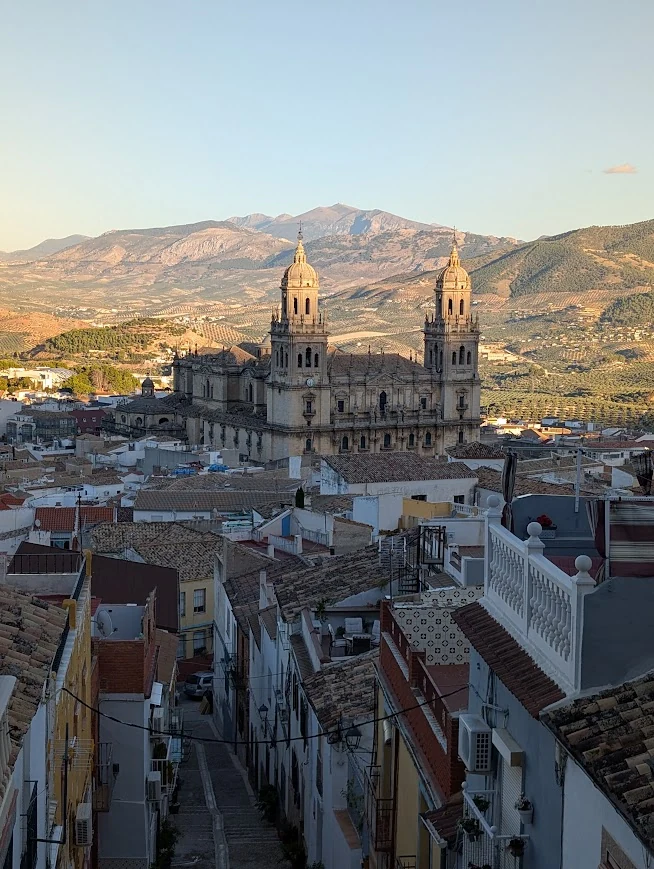
From Madinat al-Zahra we headed to Jaén, where we drove up to the Castillo de Santa Catalina with a beautiful view over the city and its cathedral. It’s free to park up there (although spots are limited) and to walk around. We checked out the city before heading to our sleeping spot in Baeza – an official campervan spot on the outskirts of the town, with toilets in the nearby bus station.
Day 3 – Baeza, Úbeda, Sierra Nevada (Los Cahorros)
We checked out Baeza and Úbeda, both towns inscribed as UNESCO sites, which is why we decided to head over. They are quite similar in style – known as Spanish Renaissance – and not really that busy. We spent about 1–2 hours in each town, walking and exploring their narrow streets. In the afternoon we headed towards Granada, where our plan was to first take advantage of the good weather and do some hiking in Sierra Nevada – the tallest mountains of the Iberian Peninsula – before they’d turn snowy as the Spanish name suggests (Sierra Nevada in Spanish means snowy mountain range).
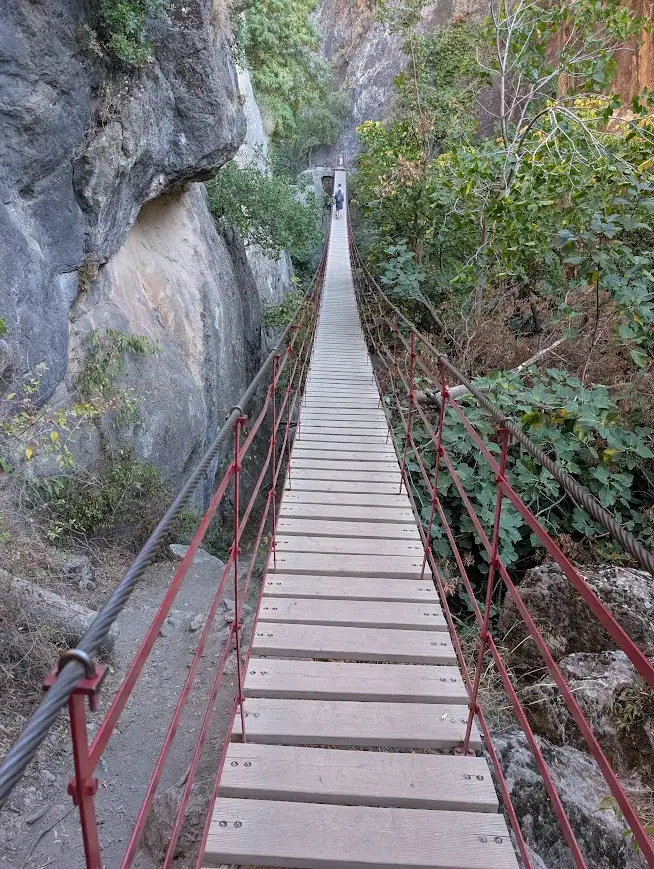
On our first afternoon of hiking, we headed to Los Cahorros, a popular trail taking you down a gorge with swing bridges and towering rocks on both sides – you might encounter some rock climbers. We did the 10km loop. There were quite a few people doing the same (Friday afternoon), even people with kids and dogs. Nothing too technical, although at one point we had to crouch down or walk on all fours to pass under some rocks.
We slept nearby at a parking lot in Monachil, a spot we found using the park4night app. No toilets, even though the app mentioned them. Plenty of local cars parked, a couple of caravans here and there. Quiet enough – some people came and went through the night.
Day 4 – Sierra Nevada (Mulhacén)
The next day we had an ambitious plan – hike the tallest mountain of mainland Spain and the whole Iberian Peninsula: Mulhacén at 3,479 meters. We decided to head to Sierra Nevada before visiting Granada specifically because of the weather forecast (check Mountain-Forecast.com before going). The peak was still snow-free and the days were sunny, but that was predicted to change soon (which came true – after a few days we’d see snowy peaks from Granada).
There are several route options, but the main one involves driving to Hoya de la Mora (2,550m) and starting there. It’s about 25km roundtrip with 1,200m of elevation gain. We are fast hikers and it took us around 8 hours. We started at 9am (after almost 1 hour of driving in the morning) – it was cold, almost freezing. The trail itself wasn’t too technical, but it was steep. If you take the shortcut, there are some chains you need to pull yourself up on (hard if you have a fear of heights), and the last scree section can be tricky if you’re afraid of slipping – but for us it was pretty standard.

We saw plenty of people. The views from the top, in all directions, were breathtaking. You can see some lakes below. There was no snow on the trail yet, but depending on the year, late October could already have some and make it slippery up top. November is usually snowy and you’d most likely need crampons until May.

After finishing the hike, we drove down to a warmer spot – La Zubia, where we shopped and found a place to sleep: a wide dirt pullover with nobody there. Occasionally, someone would park nearby to walk their dog, but at night it was very quiet. Toilets in the town only.
Day 5 – Sierra Nevada (Arenales del Trevenque), towards Granada
The next day was cloudy and drizzly – it would have been a poor day for Mulhacén. We hiked around Arenales del Trevenque, did a loop of 12.5km, taking it easy at 3.5 hours. For much of the time, we were in the clouds, and the views were limited, but the exercise was pleasant. We still saw some people (it was Sunday). After the hike, we headed to Granada, where it took us a while to find a free parking spot, 30 minutes away from the hostel. We spent the following 5 nights in Granada, which I covered in the next post.
Season
End of October was a great time for this route. Córdoba and the lower towns were still very warm – t-shirt weather during the day. Sierra Nevada is a different story: at altitude it was close to freezing. That’s actually a good window for Mulhacén – snow-free trail, clear skies, manageable cold. By November the summit is likely snowy and you’d need crampons.
Visitor numbers in Córdoba were still fairly high in late October, especially around the Mezquita. For a quieter visit, November or early December works better – just skip Mulhacén unless you’re equipped for snow.
Practical
Currency
Euro. Cards are accepted almost everywhere, but carry some cash for parking attendants or street vendors. If you’re coming from a non-euro country, use Revolut to avoid conversion fees. There’s a 1% weekend markup, but you can avoid it by exchanging currencies in the app beforehand.
SIM
Any EU SIM works under Roam Like at Home – no need to buy a local one. If you don’t have one, check eSIMDB, filter by the amount of data you need and your trip length, then sort by price.
Language
Spanish. English is widely spoken in hospitality and tourism, but not reliably outside of it. Learn at least a few phrases:
- hola – hello
- buenos días – good morning/good day
- buenas tardes – good afternoon
- buenas noches – good evening/good night
- gracias – thank you
- por favor – please
Tips Summary
- Cheapest Rentals: Search via DiscoverCars – small cars from €33.65/week (€4.81/day) at Granada Airport at the time of writing.
- Sleeping in a Car: Legal in Spain as long as you’re legally parked and all activity stays inside the vehicle. No tables or chairs outside. Local bylaws vary – check national parks and coastal areas.
- Cheap Fuel: Use Plenoil or Ballenoil instead of BP or Shell. Diesel was €1.20/L in October 2025. Use the Gasall app – Google Maps doesn’t show real-time fuel prices in Spain reliably.
- Parking: Free spots exist in all cities on this route. Expect a walk to the center. Search Google Maps. White curb = free, blue = paid, green = residents only, yellow = no parking.
- Almodóvar del Río: Drive up to the castle – most people park at the lower lot and miss this.
- Mezquita Free Entry: Mon–Sat 8:30–9:30am only. The queue moves fast once doors open.
- Córdoba Patios: Some private patios are open to visitors outside festival season. Leave a couple of coins as a donation.
- Jaén: Drive up to Castillo de Santa Catalina for a free view over the city. Limited parking spots.
- Baeza Campervan Spot: Official spot on the outskirts. Toilets in the nearby bus station.
- Baeza & Úbeda: Both UNESCO-listed, both worth 1–2 hours each. Easy to combine in one day.
- Mulhacén: Check Mountain-Forecast.com before going. Start early from Hoya de la Mora (2,550m). Allow a full day – around 8 hours for fit hikers. Snow likely from November, crampons needed until May.
- Outdoor Cooking Ban: June 1–Oct 15 in or near forested and protected areas in Andalusia. Check aemet.es before cooking outside.
- Season: Late October warm in the cities, near freezing at altitude. November quieter for Córdoba, but Mulhacén will need snow gear.
The Budget System
I keep daily travel costs under €30 using two methods:
● €3/Day Rental Car Guide
● Sleeping in Rental Cars
One week of travel cost me less than a day of work in Australia.