Cartagena to Valencia on €17/Day: 5 Cities & Sleeping in Car
Sleeping in my car between Andalusia and Catalonia: a three-night road trip through Cartagena, Murcia, Elche, Alicante, Valencia, and Peñíscola. A rental car would add €4/day to the number:
TRIP STATS
- DAILY RATE: €17.33 (per person)
- SLEEP: Sleeping in Car
- BY: Car
- PEOPLE: 2
- DAYS: 3
- TOTAL: €104.00
- CURRENCY: Euro (€)
- DATE: November 2025
- ROUTE: Cartagena → Murcia → Elche → Alicante → Valencia → Peñíscola
- TOOLS: DiscoverCars, park4night, Revolut, Lidl
| ITEM | COST (2P) | NOTES |
|---|---|---|
| Stay | €0.00 | Slept in the car. |
| Fuel | €52.00 | €17.33/day. |
| Food | €44.00 | €7.33/person per day. Shopped at Lidl. |
| Sights | €8.00 | Per person: €2 – Torres de Serranos €2 – La Lonja de la Seda |
| TOTAL | €104.00 | 3 days at €17.33/day per person |
How €17.33/day per person compares to my other trips: Budget Travel Cost per Day.

Getting There
This route works well as a continuation from Andalusia or as the first leg toward Catalonia. We covered it as part of a bigger trip, coming from Portugal and Andalusia, and continuing to Catalonia and France.
- Previous leg: Granada and Almería on €22/Day: Alhambra and Sleeping in Car
- Next leg: Barcelona & Catalonia on €22/Day: Free Montserrat Tickets
- Full trip: Spain, Portugal & France on €19/Day
Flying In
If you’re flying with open dates and small bag, tickets under €20–€30 are possible with Ryanair and Wizz Air via Skyscanner search. At the time of writing prices from the following airports for the next month are:
- Alicante Airport (ALC): under €20 to the UK, France, Italy, Germany.
- Valencia Airport (VLC): under €20 to Italy, the UK, Netherlands, France.
- Murcia Airport (RMU): under €30 to the UK, Italy, France.
If you extend your budget to €50 and search beyond the next month, flights to most countries within Europe are possible. Additionally, there are plenty of €20 flights within Spain, including to the Balearic and Canary Islands. Full list of what I pack and more carry-on rules: Sleeping in a Rental Car Packing List.
Car Rental at Alicante Airport
We did this trip in our own car, so I can’t comment on rental providers. If you’re flying into Spain, these are the current prices and things worth knowing:
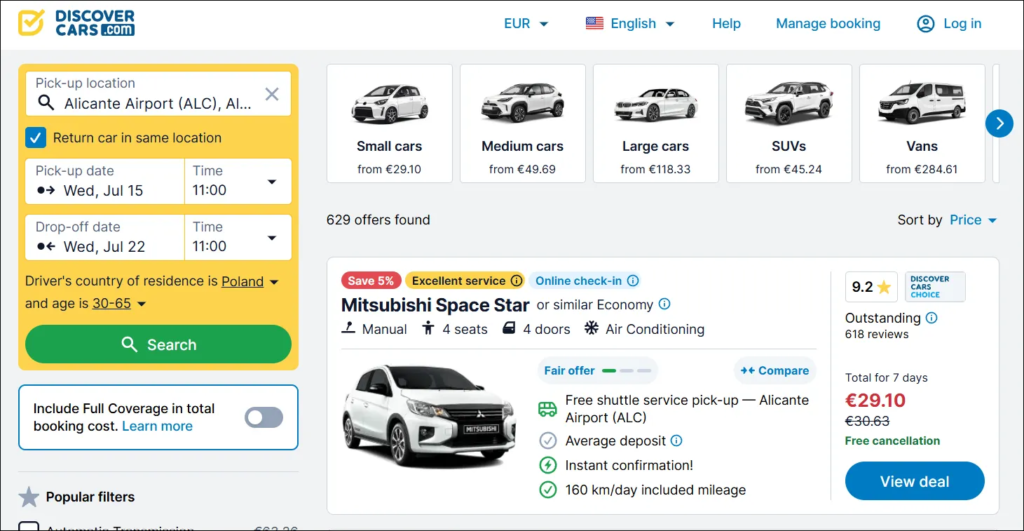
- Current Prices: Small cars at Alicante Airport from €29.10/week (€4.16/day) at the time of writing via DiscoverCars (my review). Full European Car Rental Price Comparison.
- Excess: Decline the desk insurance. Cover it with an independent policy like Cover4Rentals instead: €3/Day Rental Car Guide.
- Valencia Car Rental: Valencia Airport is another hub for rentals. However, prices are much higher than at Alicante. The cheapest weekly rental via DiscoverCars at the time of writing is €87.53 (€12.50/day).
- Tolls: We stuck to free roads throughout – the right call for sightseeing. Most of the roads in Spain are free with a few exceptions. The one to watch out for in the region is AP-7 between Vera, Cartagena, and Elche. There is a free alternative, not much slower. Set your Google Maps to “no tolls”. More ways to save: Budget Travel Tips.
- Fuel: Diesel was as low as €1.20/L during our November 2025 trip, although prices fluctuate. Spain’s fuel is consistently one of the cheapest in the EU. Unstaffed stations (like Plenoil or Ballenoil) offer significantly cheaper fuel than the big brands like BP and Shell. Google Maps didn’t reliably show real-time fuel prices in Spain. We used the Gasall app.
- Parking: We always managed to find free parking using Google Maps. In bigger cities like Valencia we had to park further out and walk, but it was manageable. Curb lines are color-coded in Spain and mean the following: white – free and unlimited parking, blue – paid parking, green – usually residents only, yellow – no parking (although you’ll see locals breaking this rule all the time).
Sleeping in a Car in Spain
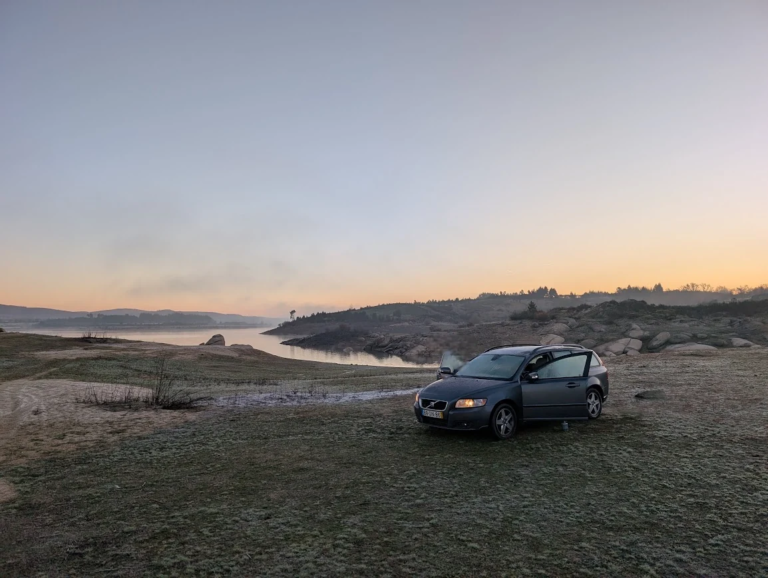
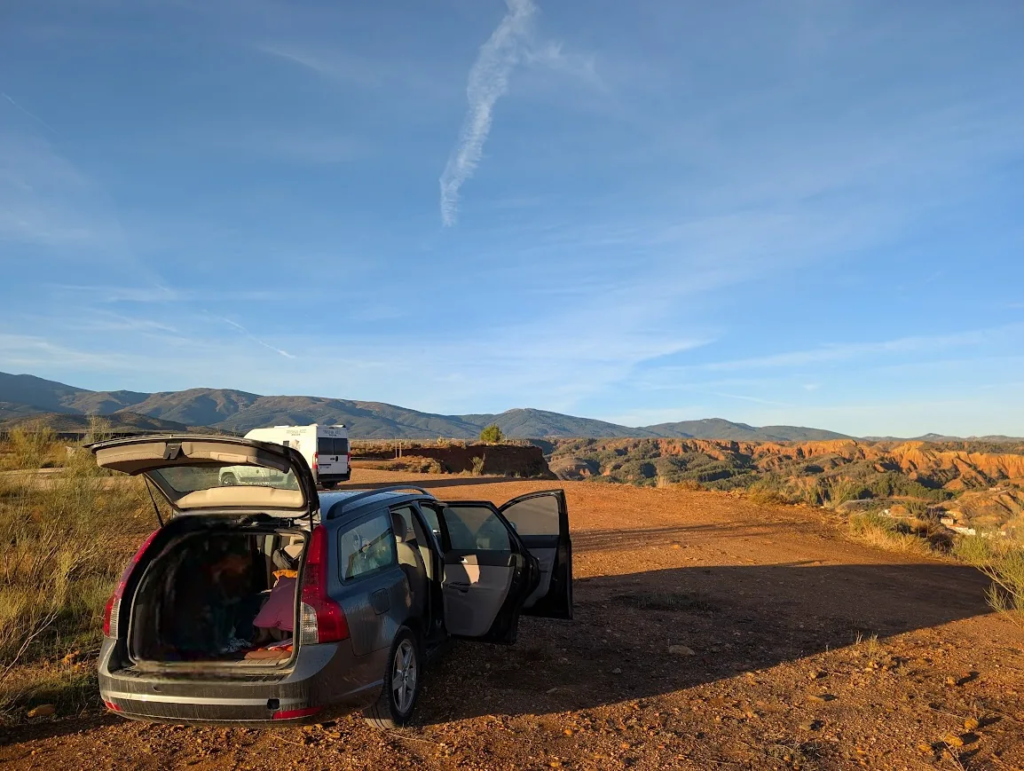
Volvo V50. 4/5. Spacious.
Long car, plenty of room for two. Rear seats folded fully flat – no step. One issue: a fixed metal bar ran across the top of the folded seatback. At 190 cm, the bar pushed my feet up slightly. An inflatable mat mostly fixed it.
Full sleeping audit: Best Rental Cars to Sleep In.
- Legality: Legal to sleep in your car in Spain as long as you are legally parked and don’t display any “camping” behavior (no tables or chairs outside the car). According to the Spanish Traffic Authority (DGT, Instruction PROT 2026/04, March 2026), a correctly parked vehicle counts as parked whether or not people are inside, as long as only the wheels touch the ground, nothing extends past the vehicle and nothing is discharged. Local bylaws sometimes ban overnight stays, particularly in natural parks and on coastal beaches. Country by country: Is It Legal to Sleep in a Rental Car in Europe? Full guide: Sleeping in Rental Cars.
- Facilities: Public toilets are sparse and unreliable in Spain. Supermarkets (mainly Lidl) were the most reliable option throughout the route – free toilets, easy to find.
- Overnight Spots: Search park4night for marked spots. I’ve linked to the spots I stayed at in the Route section below.
- Backup Accommodation: Booking.com has the widest (and usually the cheapest) selection in Spain. Sort by lowest price, filter to 7.0+ to get rid of bad listings.
Food
€44 for two people over 3 days. €7.33/day per person.
We shopped at Lidl – consistently the cheapest supermarket option across Europe. When there isn’t a Lidl nearby, Aldi is the next best alternative in Spain. Mercadona is slightly more expensive but sometimes the only option. We also shopped at Alcampo and Carrefour a couple of times on this trip for more variety, although prices were higher.
We cooked meals and made coffee on a gas stove. In Spain, outdoor cooking is banned in or near forested areas in the high fire risk season. Check current fire risk before cooking outdoors: aemet.es.
Route
Day 1 – Batería de Castillitos, Cartagena
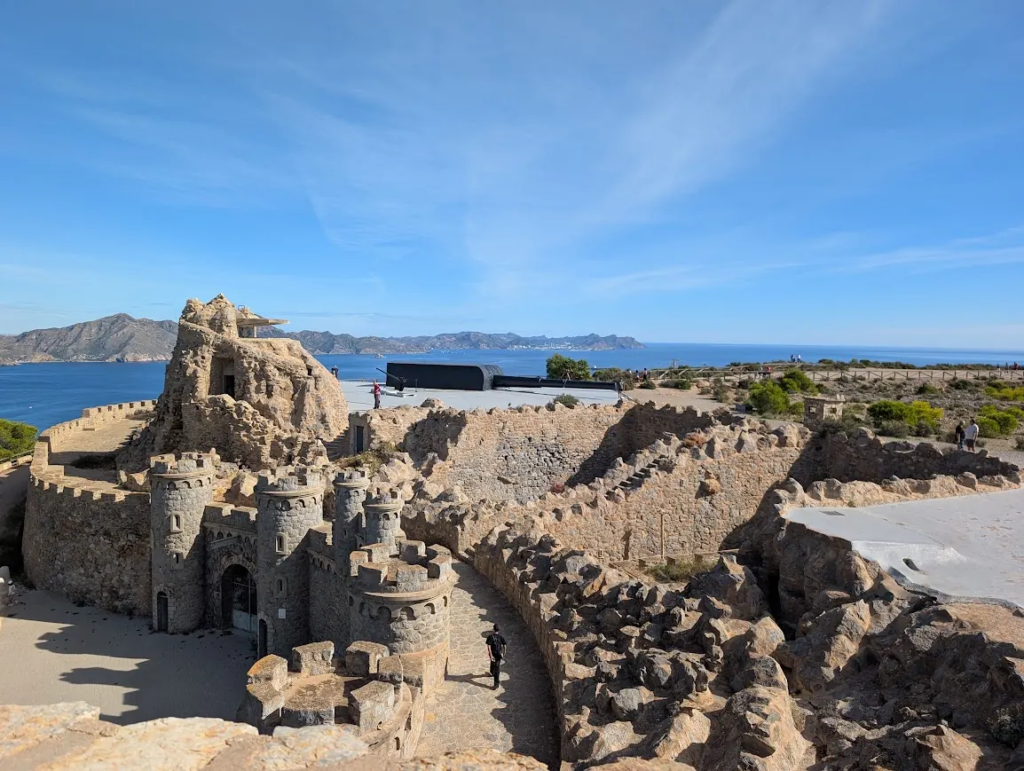
After leaving Andalusia, our first stop was Batería de Castillitos. The drive there is stunning with views over the Mediterranean Sea. The road is very narrow and can get congested, especially on the weekends, as it’s more of a destination for local Spaniards. The place itself is a 1930s artillery fortress styled to look like a medieval castle. For us, the view and drive were the main draws. It’s free, but on busy days it takes some time to score a parking spot, unless you come early.
The next stop of the day was Cartagena with its Roman Theater. It’s not a very busy city and finding free parking wasn’t hard. We climbed some public paths to get a view of the theater from the top and didn’t pay to go inside – you can see all of it pretty well from up above, and that’s where we saw the most people. If you want to get in, the ticket is €7 – the last two opening hours on Tuesdays are free.

Continuing, we visited Salinas y Arenales de San Pedro del Pinatar (salt flats and sand dunes). It’s a free-to-enter park with some walking paths on the sand and many flamingoes in the right season.

After a short hike, we continued towards Murcia where we found a sleeping spot in a forested park, just before entering the city. In the evening some people were getting back from a hike and there was music from a nearby restaurant/bar, but later it all quieted down and the night was very peaceful.
Day 2 – Murcia, Elche, Alicante
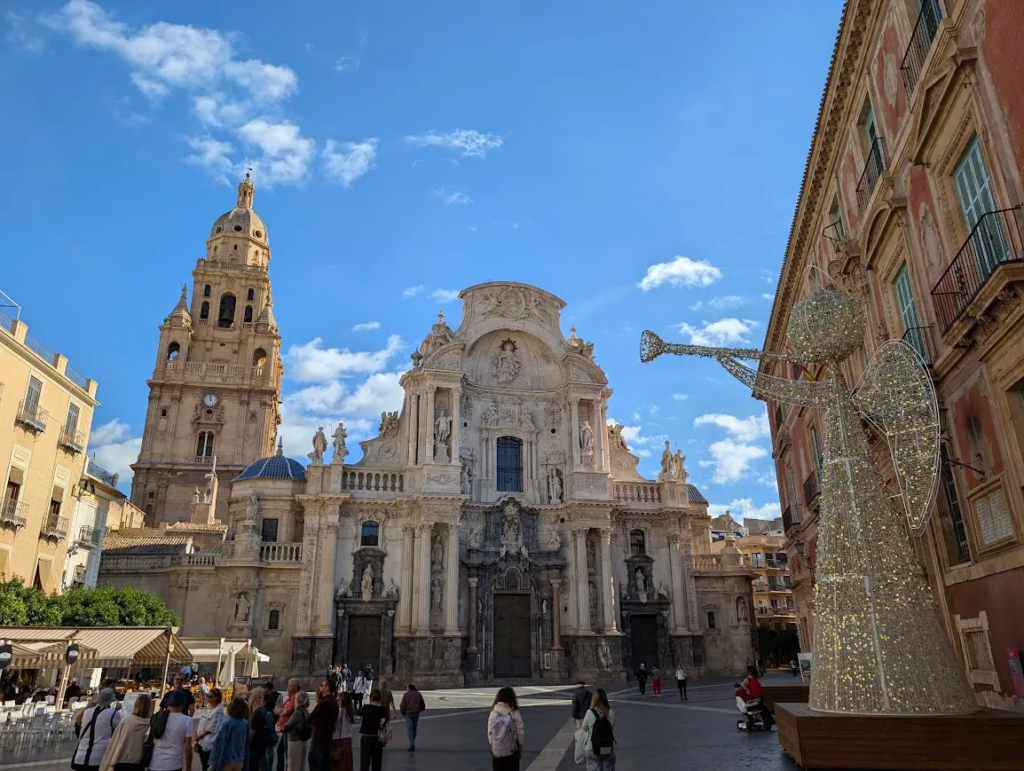
The first stop of the day was Murcia. It’s not a particularly touristic city as far as Spain goes, but it’s one of the 10 biggest in the country, and it was on our way, so we decided to check it out. Google Maps was useful to find free parking – careful with people hanging around the parking lots trying to “help” you park in exchange for change – Google reviews usually warn about them. We came early enough to avoid them, but as we were leaving we saw some of them setting up for the day. They are usually harmless, but it might be awkward to avoid them.
We spent a couple of hours walking around Murcia’s old town. It’s a pleasant city, but nothing extraordinary. There’s a cathedral, which we didn’t go inside, as we’d already seen so many cathedrals on this trip. The ticket is €6.
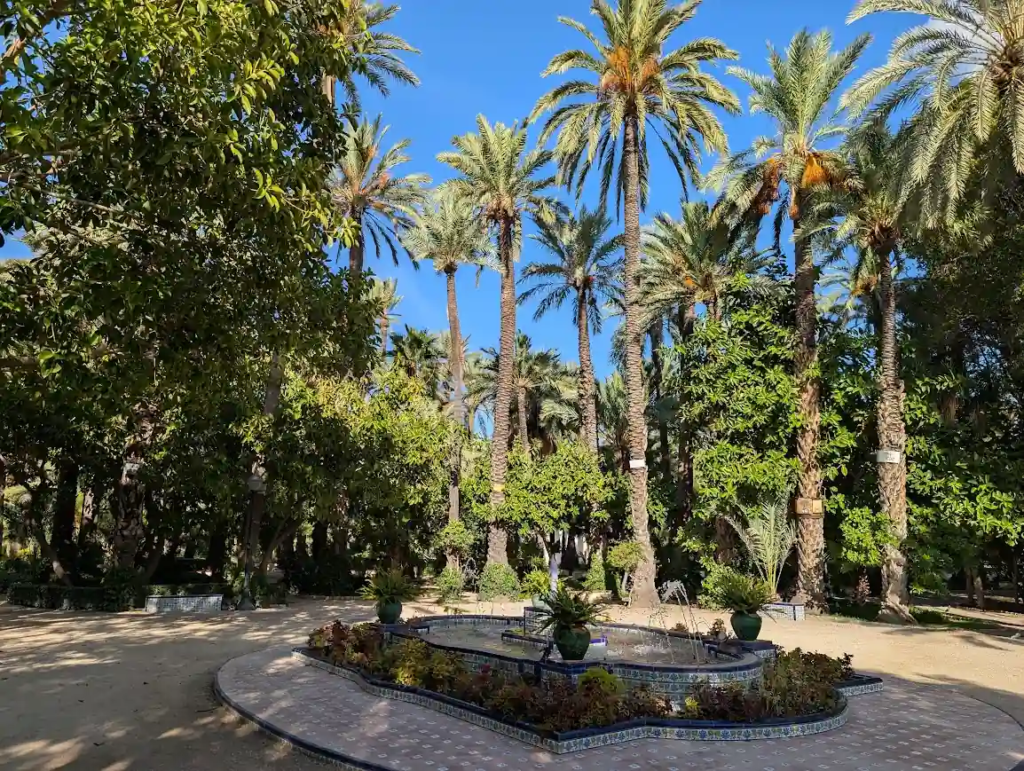
Our next stop was Elche (Elx in Valencian/Catalan). It features the UNESCO-inscribed Palmeral of Elche – a system of date palm orchards around the city, planted by the Moors over a thousand years ago. You can indeed see the palms everywhere, some parks are full of them. Also, there’s a beautiful Basílica de Santa Maria.
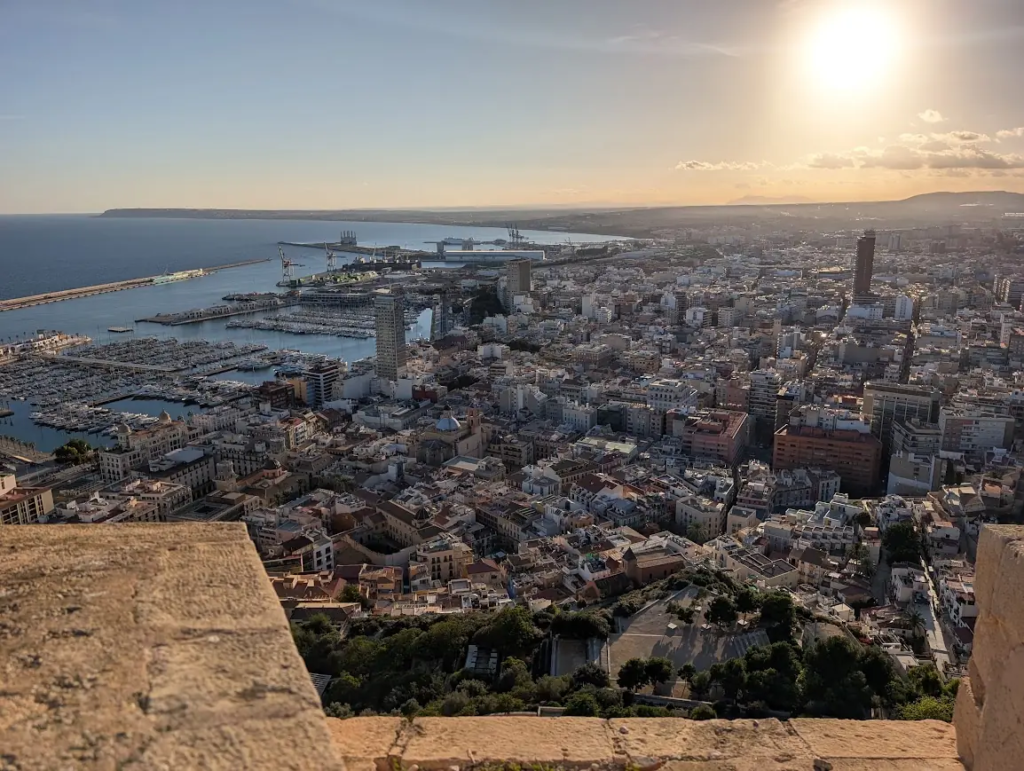
Our last stop of the day was Alicante. It is one of Spain’s most popular beach destinations, with cheap flights and plenty of mass tourism. We’re not into this sort of thing, so we just checked out its Castle of Santa Barbara. We parked way below it and hiked up. The entry is free and offers a lovely view over the city and the coast.
In the evening, we headed north, finding a secluded sleeping spot next to an empty road near the Tibi Dam.
Day 3 – Valencia
We woke up early and drove to Valencia through Gandia. We found free parking about a 40-minute walk from the city center. We walked to it through the Turia Garden, a long park in the old riverbed.
Valencia’s the third-largest city in Spain after Madrid and Barcelona, and has quite a lot going on. You can spend a couple of days there easily, but we decided to drive in early and leave late, seeing it as a day trip, which let us see the main sights and get a feel for the city.
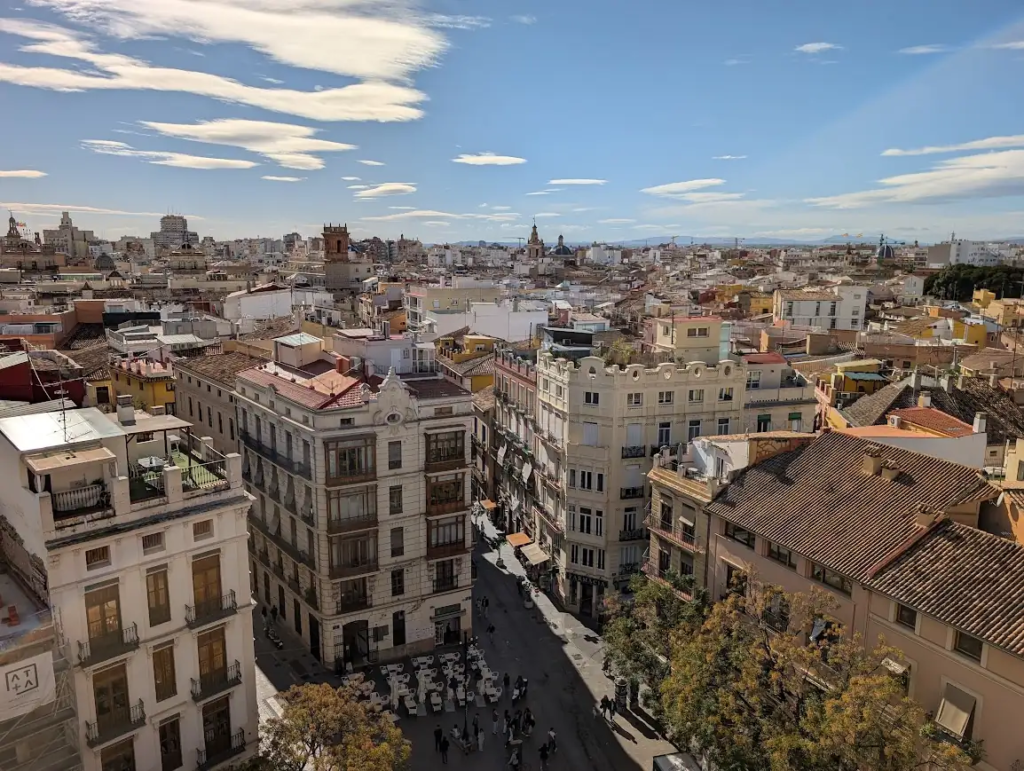
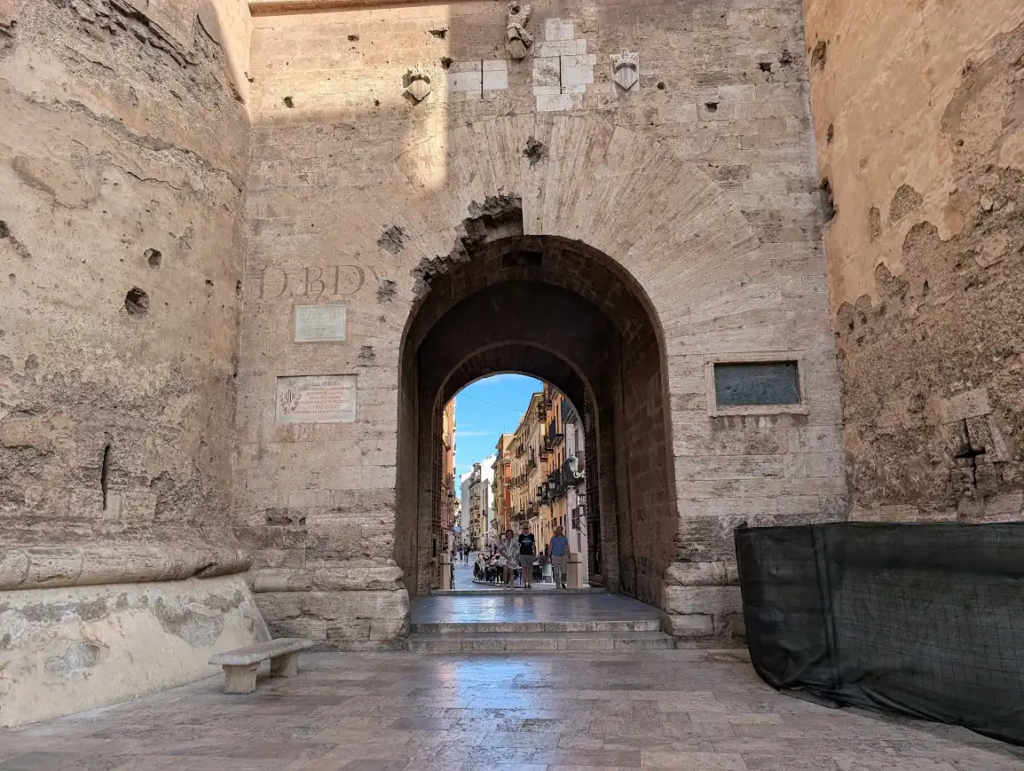
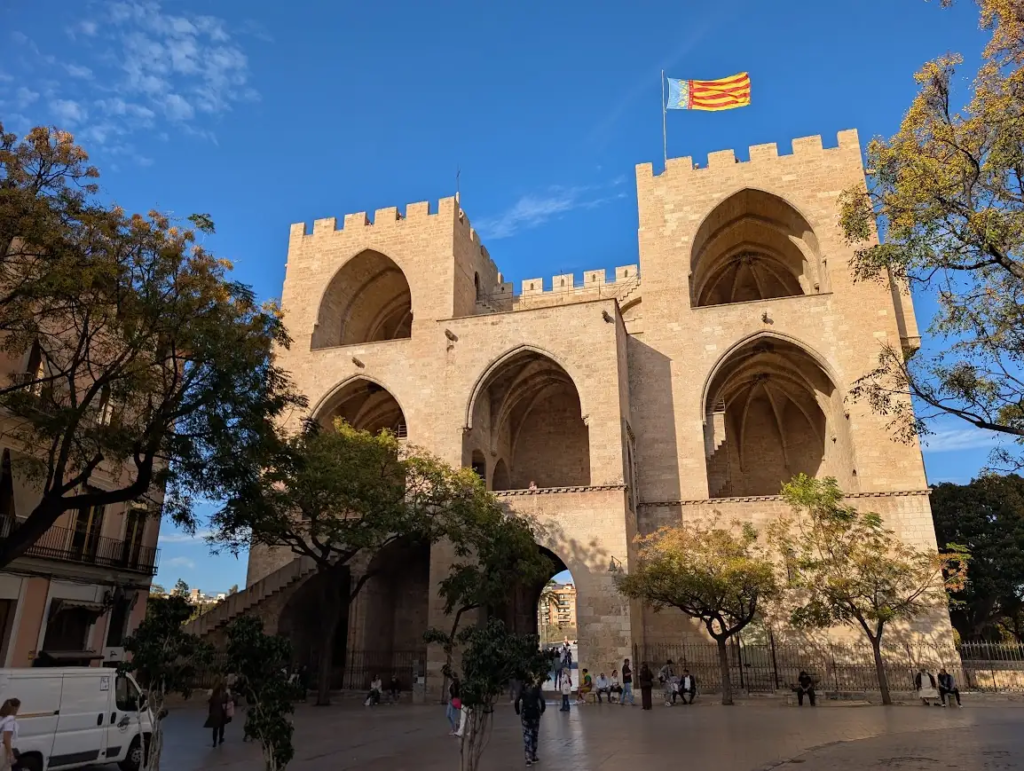
The sights are cheap. We climbed the city gate of Torres de Serranos for €2. We didn’t go inside the cathedral for the reasons I mentioned earlier – we’d seen so many cathedrals in Spain already that we were content to just have a glimpse from the outside. If you decide to go in, the general admission is €12, a bit pricey. The cathedral is known for supposedly holding the Holy Chalice (the Holy Grail), but that’s debatable.
We also visited La Lonja de la Seda de Valencia – again, €2 admission. It’s a 15th-century Gothic building that served as the center of the silk trade and is recognized as a UNESCO site. While beautiful and definitely worth the ticket price, we didn’t really understand why this particular building would be on the UNESCO list.
We spent the rest of the day walking around the city, visiting its food market. The other city gate was closed for renovation, but usually you can also climb it for €2. The old town is large enough to wander for hours. On the way out back to the car we walked through more of a livable part of the city.
In the evening we drove out and found an overnight spot close to the coast, full of campervans – clearly a popular place.
Continuing to Catalonia – Valltorta and Peníscola
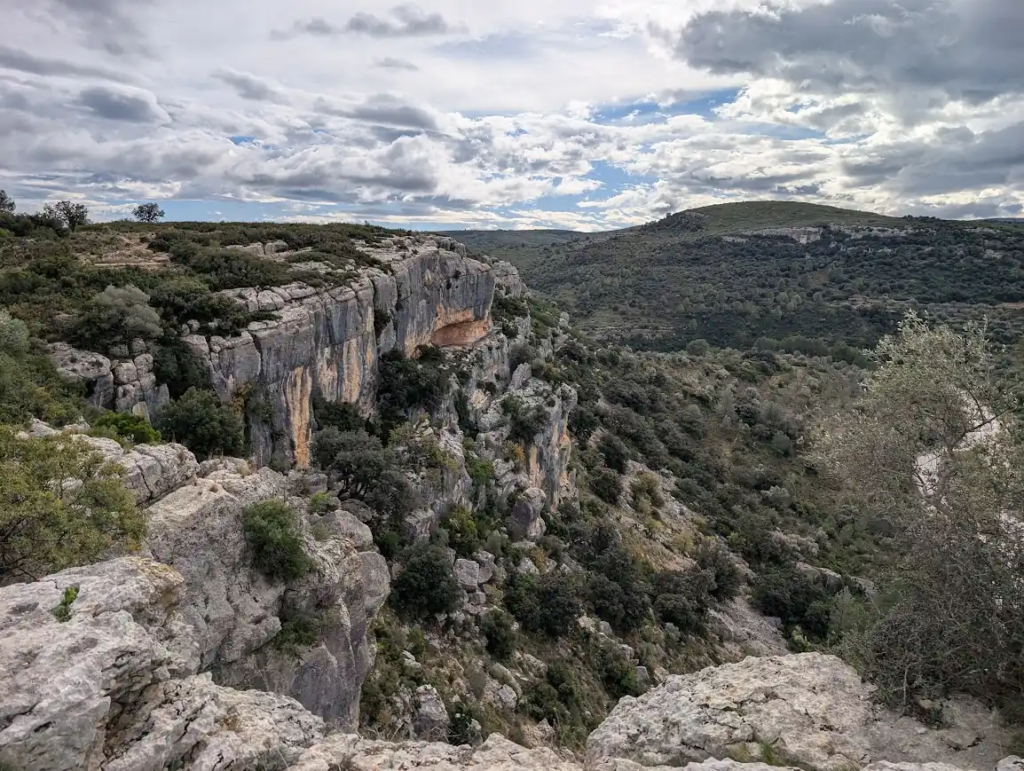
We started driving towards Catalonia, passing by Castelló de la Plana, without stopping. We chose a lesser-known stop next – Museo de la Valltorta, a free museum of prehistoric rock art. Once we arrived there, we learned that they also offer free guided tours to the rock art on a cliff wall. We barely caught the last one before siesta at 12 PM – be mindful of the schedule. The museum would then only reopen at 5 PM. The tour had already left, so staff told us which way to go to catch up – the art is about 1 km from the museum. We caught up and got to see it. The tour was unfortunately Spanish only and we didn’t understand much. There were about 10 Spanish tourists there with us. A cool experience with a very local feel.
Our last stop before crossing over to Catalonia was Castell de Peníscola, a 14th-century fortress located on a cliff above the Mediterranean Sea. A picturesque spot, used as a filming location for many movies, including Game of Thrones.

Season
We visited this part of Spain in early November after having spent October in Andalusia and Portugal. You could feel the nights getting colder, although the climate was still very pleasant. The crowds were mostly gone – Andalusian cities are generally more touristic anyway.
Low season runs November to February, and that’s the timing I recommend. I’d definitely avoid July–August due to peak visitor numbers and potential heat waves.
Practical
Currency
Euro. Cards are accepted almost everywhere, but carry some cash for parking attendants and street vendors. If you’re coming from a non-euro country, use Revolut to avoid conversion fees. There’s a 1% weekend markup, but you can avoid it by exchanging currencies in the app beforehand.
SIM
Any EU SIM works under Roam Like at Home – no need to buy a local one. If you don’t have one, check eSIMDB, filter by the amount of data you need and your trip length, then sort by price.
Language
Spanish. English is widely spoken in hospitality and tourism, but not reliably outside of it. Learn at least a few phrases:
- hola – hello
- buenos días – good morning/good day
- buenas tardes – good afternoon
- buenas noches – good evening/good night
- gracias – thank you
- por favor – please
Tips Summary
- Cheapest Rentals: Search via DiscoverCars – small cars from €29.10/week (€4.16/day) at Alicante Airport at the time of writing.
- Sleeping in a Car: Legal in Spain as long as you’re legally parked and all activity stays inside the vehicle. No tables or chairs outside. Local bylaws vary – check natural parks and coastal beaches.
- Avoid the AP-7 Toll: Free alternative between Vera, Cartagena, and Elche, not much slower. Set Google Maps to “no tolls.”
- Cheap Fuel: Use Plenoil or Ballenoil instead of BP or Shell. Diesel was around €1.20/L in November 2025. Use the Gasall app – Google Maps doesn’t show real-time fuel prices in Spain reliably.
- Parking: Free spots all over Murcia, Alicante, and Valencia. Search on Google Maps and expect a walk in bigger cities. White curb = free, blue = paid, green = usually residents only, yellow = no parking.
- Cartagena Roman Theater: Skip the €7 ticket. Climb the public paths above for a full view, free. Last two opening hours on Tuesdays are free if you want to go in.
- Batería de Castillitos: Free. Come early on weekends – parking fills up fast with local visitors.
- Valencia Sights: Cheap at €2 each for Torres de Serranos and La Lonja de la Seda.
- Museo de la Valltorta: Free, including guided rock art tours. Last tour before siesta leaves around 12 PM.
- Outdoor Cooking Ban: Banned in or near forested areas during high fire risk season in Spain. Check aemet.es before cooking outside.
- Season: Early November is quiet and mild – nights getting cooler but still pleasant. Low season runs November to February. Avoid July–August for crowds and heat.
The Budget System
I keep daily travel costs under €30 using two methods:
● €3/Day Rental Car Guide
● Sleeping in Rental Cars
One week of travel cost me less than a day of work in Australia.