Central Spain on €18/Day: Madrid & 5 Nights Sleeping in Car
Madrid, Toledo, Segovia, Salamanca, Ávila and Zamora in 8 days, with free museum hours in Madrid. We used our own car – a rental would add around €6.75/day per person:
TRIP STATS
- DAILY RATE: €17.88 (per person)
- SLEEP: Sleeping in Car (5 nights), Hostel (3 nights)
- BY: Car
- PEOPLE: 2
- DAYS: 8
- TOTAL: €286.10
- CURRENCY: Euro (€)
- DATE: December 2025
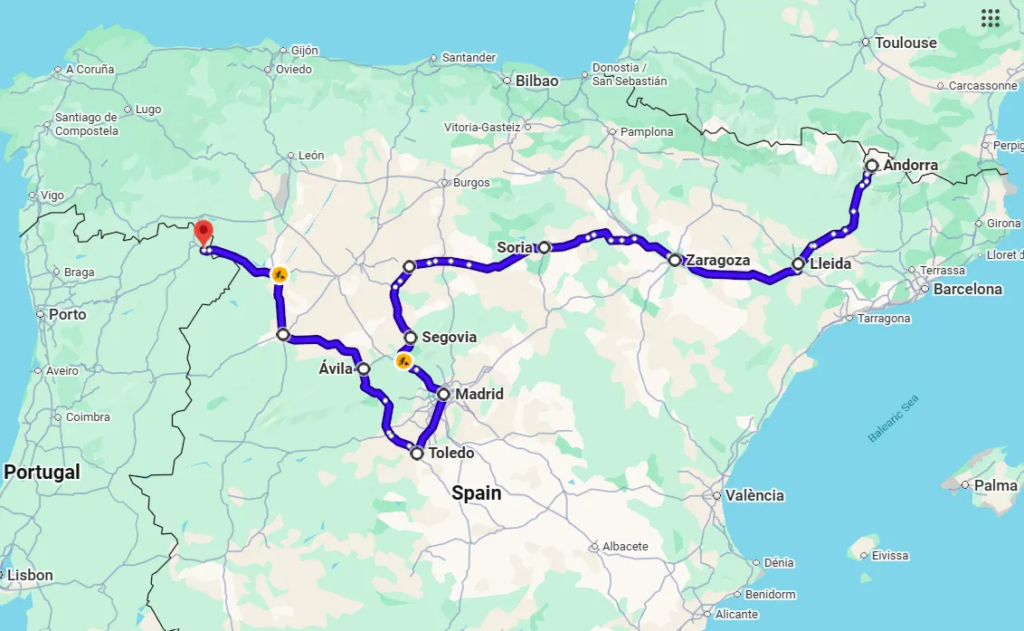
- ROUTE: (Andorra →) Lleida → Zaragoza → Soria → Segovia → Madrid → Toledo → Ávila → Salamanca → Zamora (→ Portugal)
- TOOLS: DiscoverCars, park4night, Revolut, Lidl
| ITEM | COST (2P) | NOTES |
|---|---|---|
| Stay | €66.10 | 3 nights: Madrid hostel. Hostal Chueca – €11.02/night per bed. 5 nights: slept in the car – €0/night |
| Fuel | €93.00 | €11.63/day. |
| Food | €107.00 | €6.69/day per person. Shopped at Lidl. |
| Sights | €20.00 | Per person: €7 – Aljafería Palace (Zaragoza) €3 – Sinagoga del Tránsito (Toledo) |
| TOTAL | €286.10 | 8 days at €17.88/day per person |
How €17.88/day per person compares to my other trips: Budget Travel Cost per Day.
Getting There
This route works well as a continuation from Portugal or France. We covered it as part of a bigger trip, coming from France/Andorra, and continuing to Portugal.
- Previous leg: Southern France & Andorra on €24/Day: Sleeping in the Car
- Next leg: North and Central Portugal on €21/Day: Sleeping in a Car
- Full trip: Spain, Portugal & France on €19/Day
Flying to Madrid (MAD)
If you’re flying with open dates and a small bag, tickets under €20 are possible with Ryanair and Wizz Air via Skyscanner search. At the time of writing, flights from the UK, Italy, France, Portugal, Morocco start at €15. €20 flights are possible to Poland, Luxembourg, Albania and Ireland. If you extend the budget to €50, it’s possible to get to most of the European countries. Full list of what I pack and more carry-on rules: Sleeping in a Rental Car Packing List.
Car Rental at Madrid Airport
We did this trip in our own car, so I can’t comment on rental providers. If you’re flying into Spain, these are the current prices and things worth knowing:

- Current Prices: Small cars at Madrid Airport from €94.46/week (€13.49/day) at the time of writing via DiscoverCars (my review). Full European Car Rental Price Comparison.
- Excess: Decline the desk insurance. Cover it with an independent policy like Cover4Rentals instead: €3/Day Rental Car Guide.
- Tolls: We stuck to free roads throughout, which is easy across Central Spain. State autovías (A-2, A-42, A-50, A-66) are completely toll-free, and the old AP-2 between Lleida and Zaragoza has been free since 2021. The main toll traps on this leg are around Madrid and the Sierra de Guadarrama: the AP-6 tunnel, AP-61 (Segovia), AP-51 (Ávila), and the AP-41 to Toledo. We bypassed all of them by taking free national roads and mountain passes (CL-601/M-601 over Navacerrada via La Granja to El Escorial, and the free A-42 to Toledo) – slower, but far more scenic.
- Fuel: Diesel was as low as €1.30/L during our December 2025 trip, although prices fluctuate. Spain’s fuel is consistently one of the cheapest in the EU. Unstaffed stations (like Plenoil or Ballenoil) offer significantly cheaper fuel than the big brands like BP and Shell. Google Maps didn’t reliably show real-time fuel prices in Spain. We used the Gasall app.
- Parking in Madrid: We parked in Pozuelo de Alarcón, a 5-minute walk from the train station. The neighborhood is very safe and has plenty of free street parking. Because it sits outside Madrid’s Low Emission Zone (ZBE), you do not need an environmental sticker or worry about fine restrictions. Train tickets into central Madrid are cheap and frequent. Curb lines in Spain follow standard color coding: white means free and unlimited parking, blue is paid parking, green is resident-priority, and yellow means no parking.
- Low Emission Zone (ZBE): Unlike Barcelona, Madrid’s ZBE operates 24/7/365 across the entire municipality, including the inner M-30 ring road. Outer ring roads like the M-40, M-45, and M-50 lie outside restricted municipal limits and remain open to all transit traffic. Spanish rental cars carry DGT environmental badges (B, C, ECO, or Zero) and can drive in the general ZBE without issue. However, driving into the central Distrito Centro zone requires parking directly in an official public garage to avoid an automated €200 fine. Foreign-plated vehicles require advance registration with Madrid authorities before entering. Parking in Pozuelo de Alarcón avoids the ZBE system completely.
Sleeping in a Car in Spain
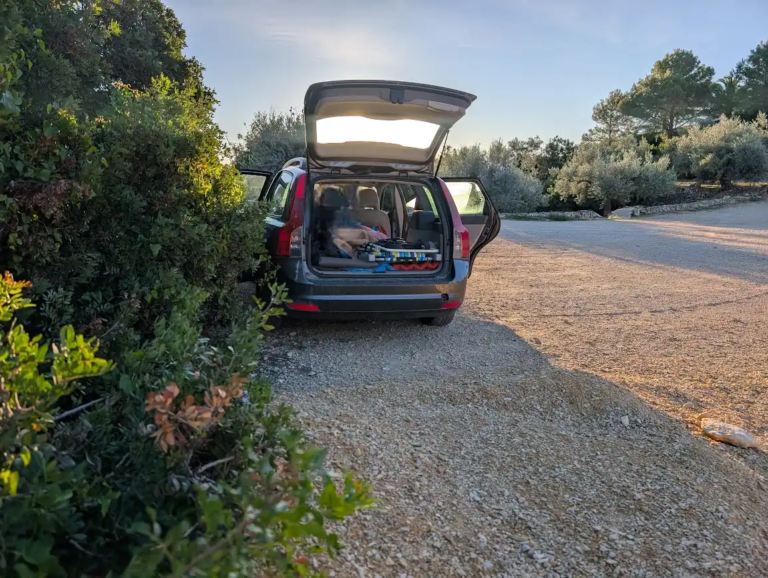
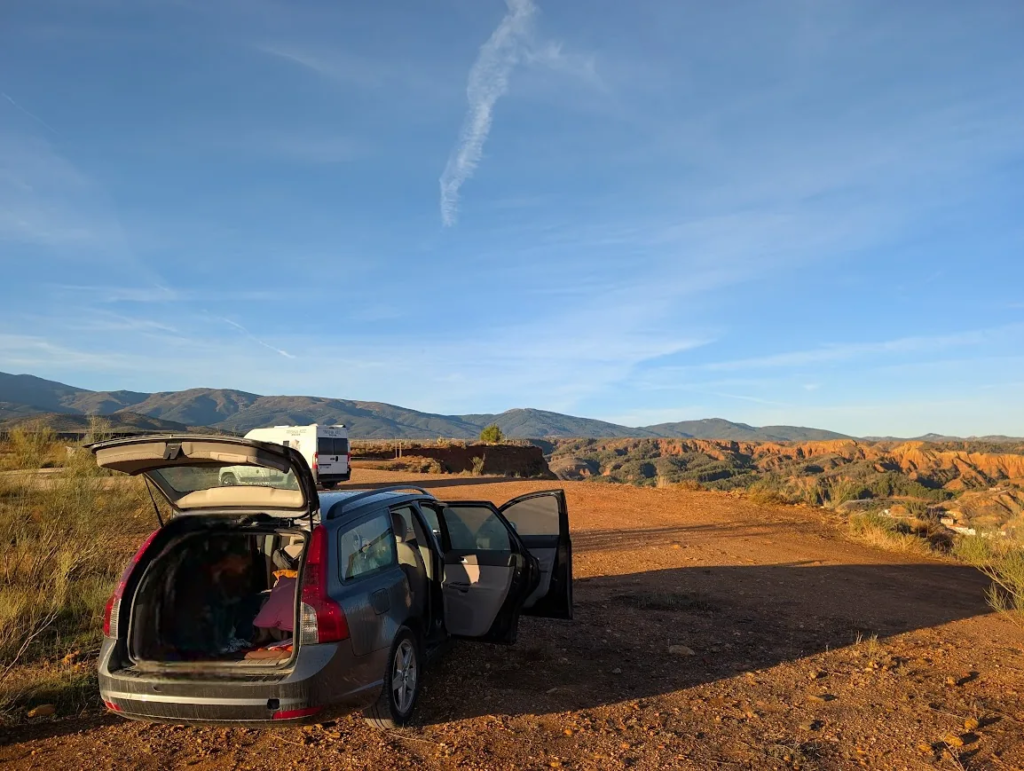
Volvo V50. 4/5. Spacious.
Long car, plenty of room for two. Rear seats folded fully flat – no step. One issue: a fixed metal bar ran across the top of the folded seatback. At 190 cm, the bar pushed my feet up slightly. An inflatable mat mostly fixed it.
Full sleeping audit: Best Rental Cars to Sleep In.
- Legality: Legal to sleep in your car in Spain as long as you are legally parked and don’t display any “camping” behavior (no tables or chairs outside the car). According to the Spanish Traffic Authority (DGT, Instruction PROT 2026/04, March 2026), a correctly parked vehicle counts as parked whether or not people are inside, as long as only the wheels touch the ground, nothing extends past the vehicle and nothing is discharged. Local bylaws sometimes ban overnight stays, particularly in natural parks and on coastal beaches. Country by country: Is It Legal to Sleep in a Rental Car in Europe? Full guide: Sleeping in Rental Cars.
- Facilities: Public toilets are sparse and unreliable in Spain. Supermarkets (mainly Lidl) were the most reliable option throughout the route – free toilets, easy to find.
- Overnight Spots: Search park4night for marked spots. I’ve linked to the spots I stayed at in the Route section below.
- Backup Accommodation: Booking.com has the widest (and usually the cheapest) selection in Spain. Sort by lowest price, filter to 7.0+ to get rid of bad listings.
Staying in Madrid
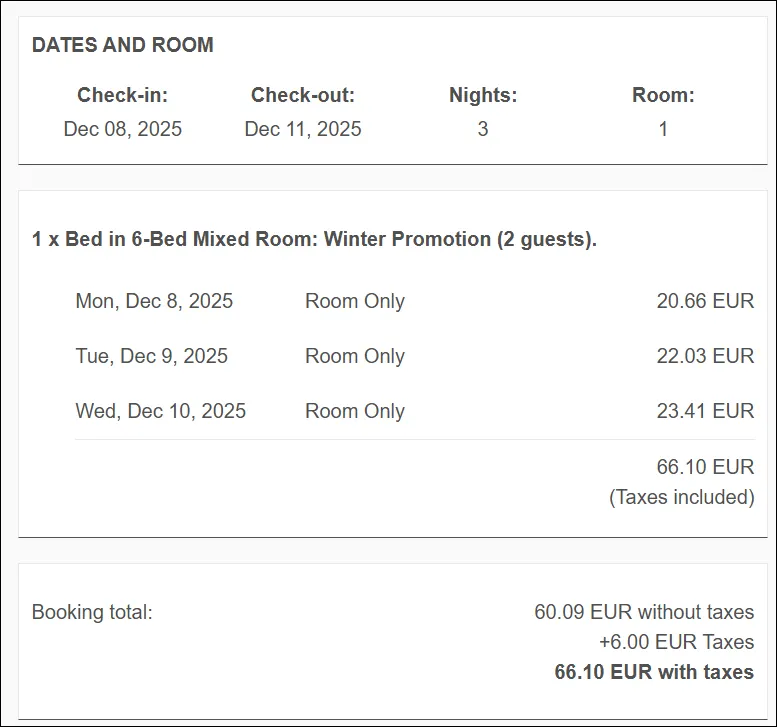
We spent 3 nights in Madrid. We stayed at Hostal Chueca, which was the cheapest place with decent reviews. They ran a winter promo on their website. It ended up costing around €11/night per bed, great price for Spain, better than anything else on Booking.com, but check them for deals as well. Madrid doesn’t charge a tourist tax as opposed to many other locations in Spain.
The place was comfy and clean. It didn’t have a proper kitchen, just a big room where they served breakfast with a microwave and kettle available.
Food
€107 for two people over 8 days. €6.69/day per person.
We mostly shopped at Lidl – consistently the cheapest supermarket option across Europe. When there isn’t a Lidl nearby, Aldi is the next best alternative in Spain. Mercadona is slightly more expensive but sometimes the only option. We also shopped at Alcampo and Carrefour a couple of times on this trip for more variety, although prices were higher.
We cooked meals and made coffee on a gas stove. In Spain, outdoor cooking is banned in or near forested areas in the high-fire-risk season. Check current fire risk before cooking outdoors: aemet.es.
Route
Leaving Andorra
After leaving Andorra, we had a quick stop in La Seu d’Urgell. Interestingly, its cathedral is the seat of the bishop, one of the co-princes of Andorra, with the other being the President of France.
We kept driving through scenic mountain country and so, so many tunnels. We slept at a pull-off, not too far off the main road. It was peaceful, but freezing.
Day 1 – Lleida, Zaragoza
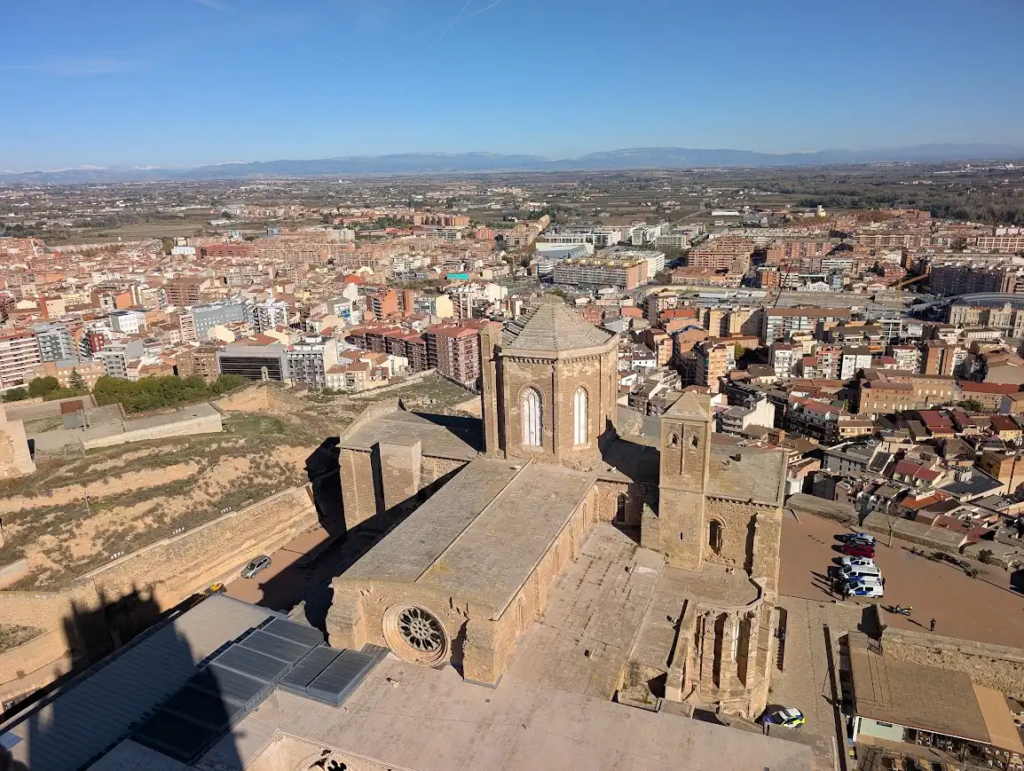
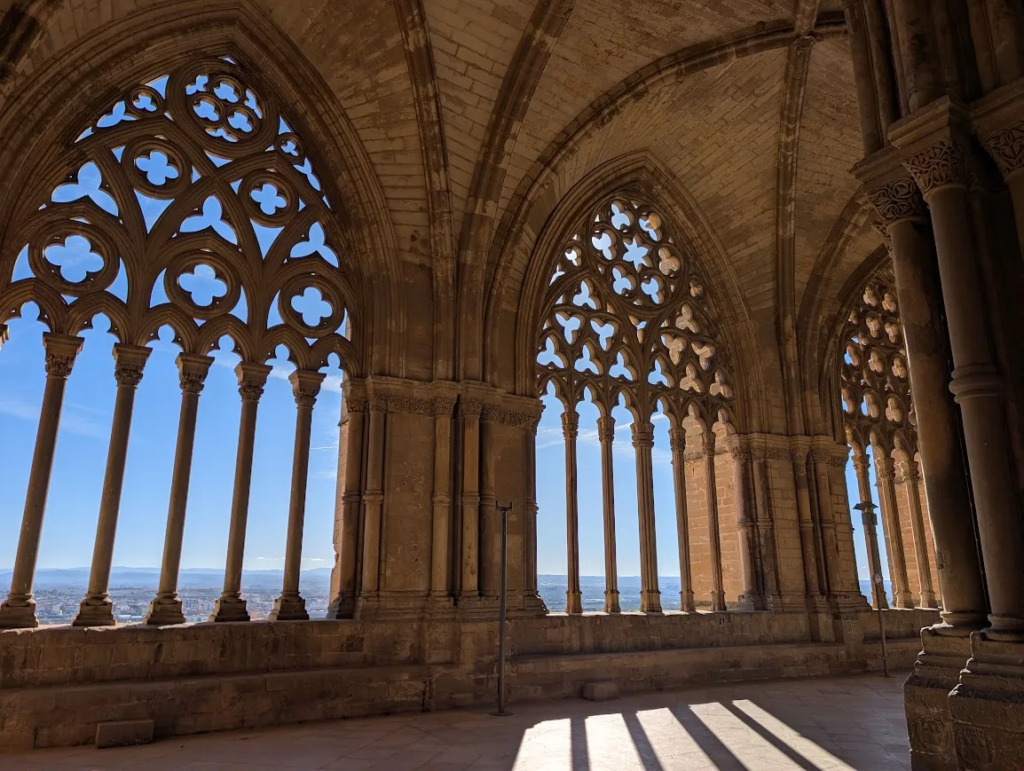
We spent the first half day in Lleida, back in Catalonia. It has a beautiful cathedral (La Seu Vella), and due to some local celebration it was free to enter on the day of our visit. The city itself gets quite busy, but has a very old and authentic feeling to it.
Next, after a fair bit of driving, we arrived in Zaragoza, Aragon. Even though it was out of season, it felt busy, already with a winter/Christmas atmosphere. We got tickets to enter Aljafería Palace, an 11th-century Islamic palace, heavily reconstructed. To be honest, we didn’t find it particularly interesting compared to the more impressive Islamic palaces found in Andalusia.
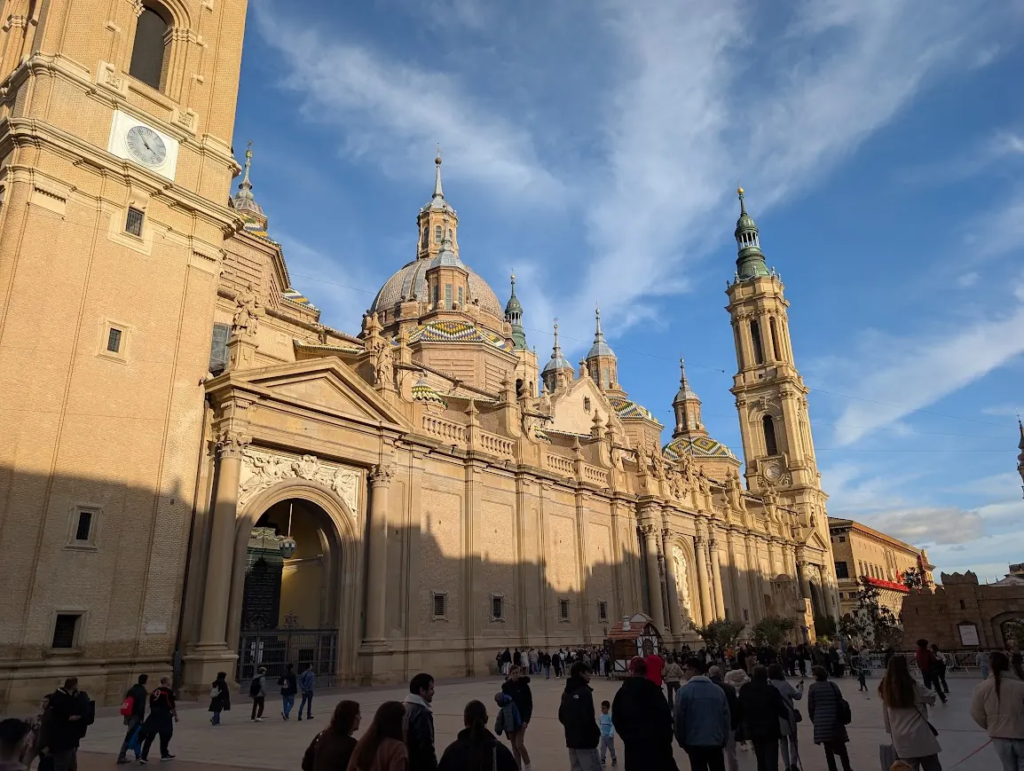
We walked into the old town, visiting a couple of churches and an old bridge. It felt like a very livable city.

For the night we stayed at an official caravan spot near a village by Moncayo Natural Park. There was another campervan there, and the night was super peaceful.
Day 2 – Tarazona, Soria, Segovia
In the morning we randomly visited a nearby town – Tarazona. We hadn’t heard of it before, yet it was so beautiful, with old, narrow streets. Spain is like that – you can find charming towns in every corner.
It was a day of lots of driving, as we were in a bit of a hurry due to the oncoming cold, and wanted to make it to Segovia that day. We stopped in Soria and hiked to Ermita de San Saturio, which was a nice break in the long drive. We also made another short stop close to Peñafiel Castle.
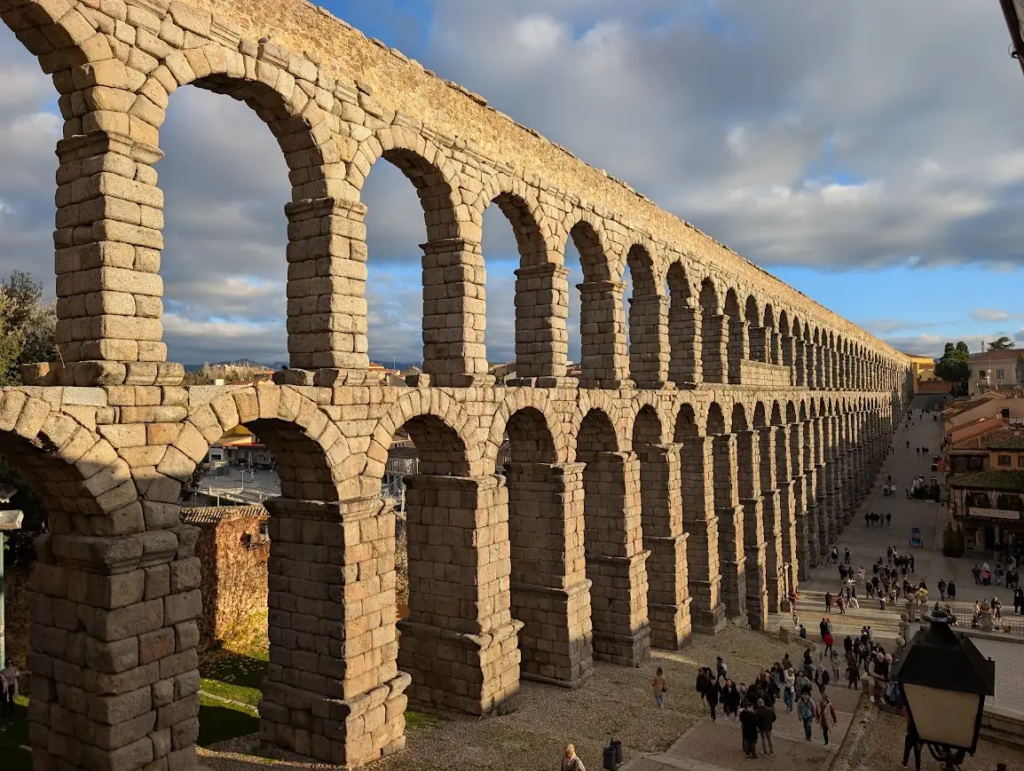
When we finally arrived in Segovia, it was late afternoon. It was actually quite busy, mostly due to its proximity to Madrid, I think. The city is known for the super famous Segovia Aqueduct – a massive monument from Roman times, predominantly kept in its original form. The whole city is worth a solid walk around, and the views of its Alcázar from a distance are very impressive.
We spent the night at a small parking near Real Sitio de San Ildefonso, on the way into a park. There were some people with dogs passing by, especially in the morning, but nothing crazy.
Day 3 – La Granja, El Escorial, Madrid
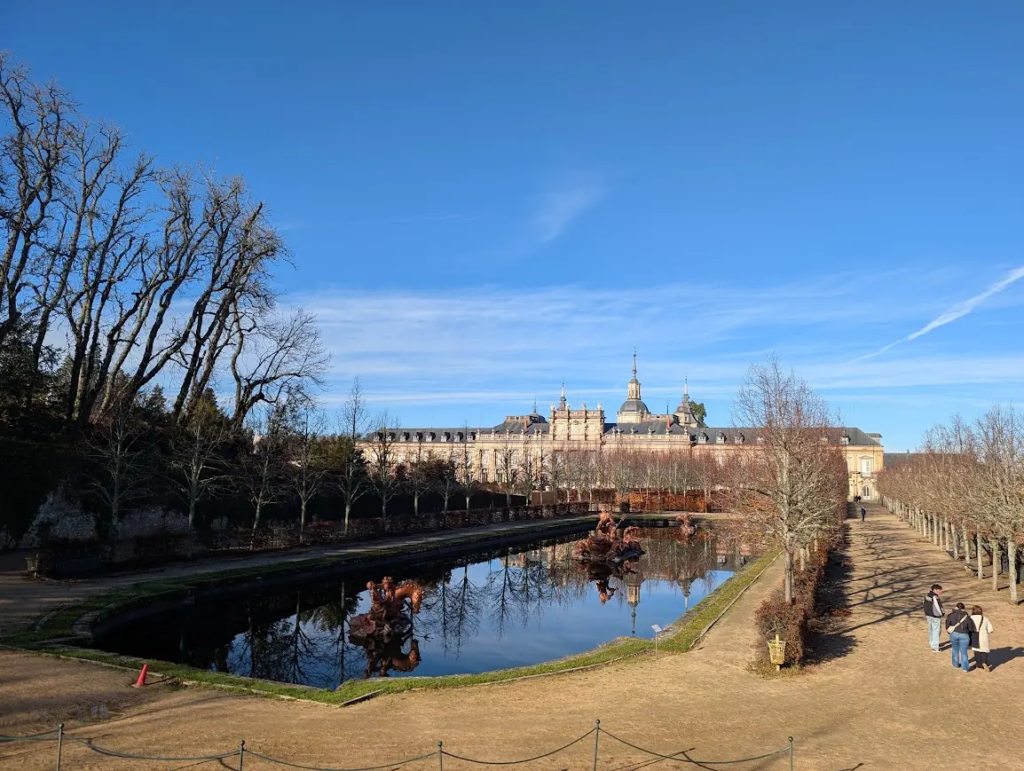
We started off the day by visiting the grounds of the Royal Palace of La Granja de San Ildefonso, and then continued on to the grounds of the Royal Site of San Lorenzo de El Escorial. We didn’t go inside either one, just walked the grounds, which are free. They are both historic residences of Spanish kings, and in that way a bit similar. There are a couple more places like this around Madrid. Between these two royal sites we also had a bit of a hike off a mountain pass.
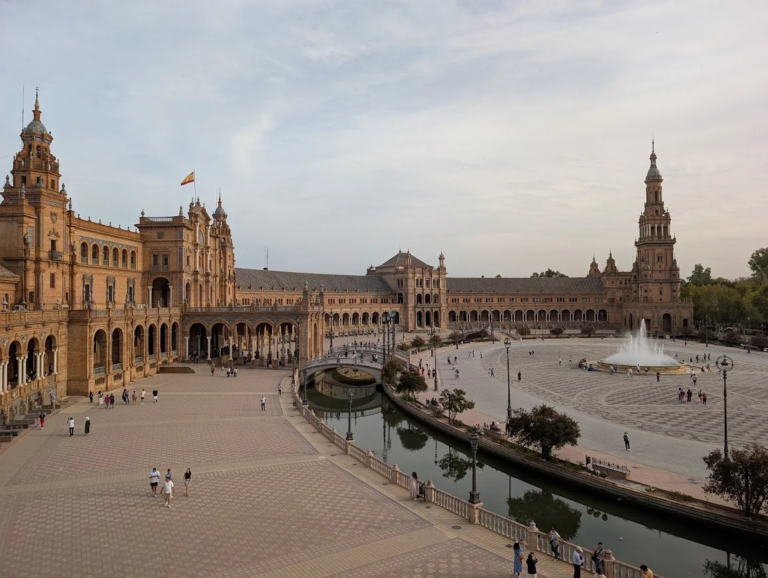
In the late afternoon we parked our car in Pozuelo de Alarcón for 3 nights (see the car section above) and took the train into Madrid, where we had booked a hostel in Chueca.
Day 4–5 – Madrid
In Madrid we were based in Chueca, a vibrant district with lots of life.
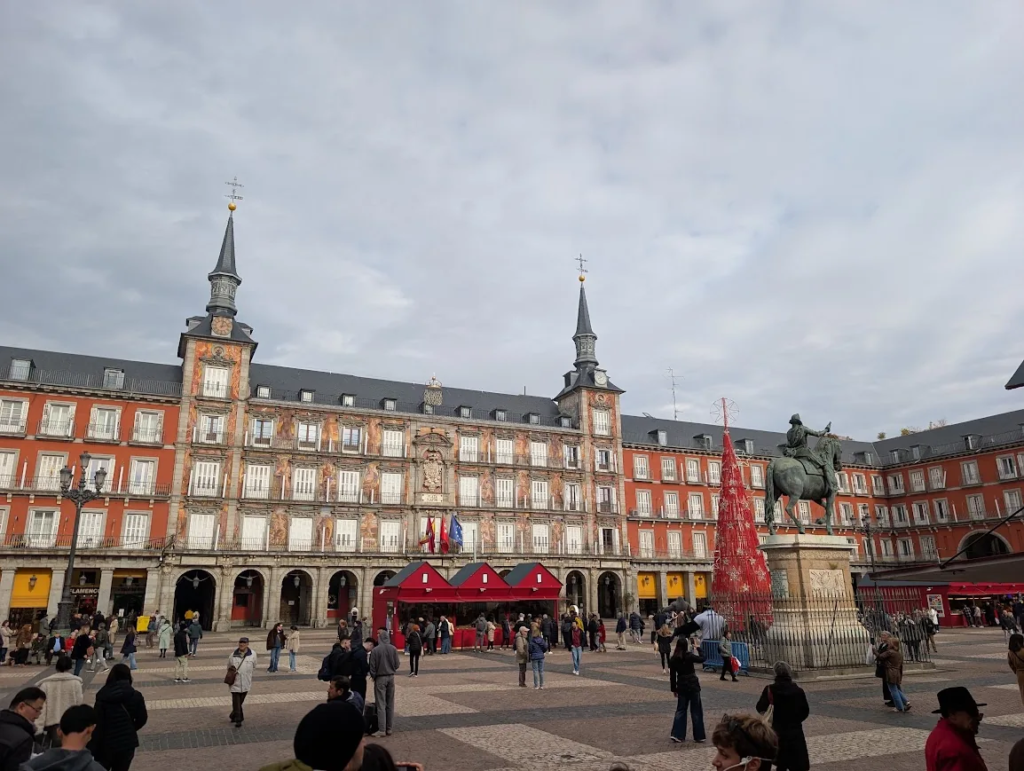
We spent the first day walking around the city, visiting Plaza Mayor and Puerta del Sol (two main squares) and the famous El Retiro, a massive park right in the middle of the city. In the evening we headed to Museo Nacional del Prado – free during the last two hours of its opening every day. Regular admission is €15, so timing it right saves €30 for two. The queue lasted about 30–40 minutes, but in the high season it could take longer, not leaving you with much time inside. It’s a very big museum and features many renowned masterpieces by Velázquez, Goya, El Greco and El Bosco (Hieronymus Bosch).
Our second day was based around taking advantage of other free sights. First we headed to the Temple of Debod – an authentic Egyptian temple, dismantled and gifted to Spain by Egypt in recognition of Spain’s help in saving other monuments from flooding. It’s free to visit, but you need to secure a timed-entry slot online.
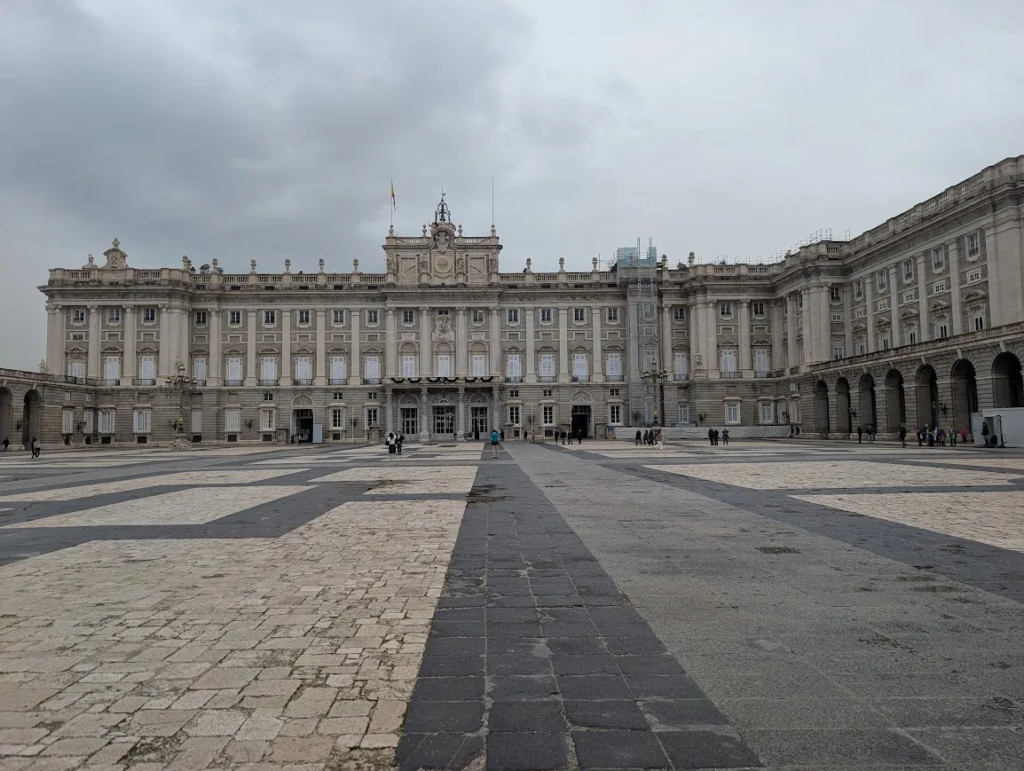
Not far from there is the Royal Palace of Madrid – free Monday to Thursday during the last two hours of operation for citizens of the EU or Latin America (with ID or a residence or work permit). Regular admission is €18. Again, the queue can take up to an hour.
The last stop of the day was Museo Reina Sofía, with famous works by Pablo Picasso (including Guernica) and Salvador Dalí. Same deal – the last two hours are free, saving the €12 admission, but you need to pre-book on their official website. No queueing needed. More ways to find free entry days: Budget Travel Tips.
Day 6 – Toledo
We woke up, took the train back to our car and drove on to Toledo. It’s a former capital city of Spain, located on top of a gorge carved by the Tagus River, and a big tourist destination. Three cultures mixed here – Christian, Muslim and Jewish – and you can still notice that by exploring its sights. We paid €3 to visit Sinagoga del Tránsito, and it was a great introduction to the history of Jews in Spain along with their expulsion outlined on the information boards inside. Toledo Cathedral is one of the most important historical cathedrals in Spain (construction began in the 13th century). To top off our visit, we drove to the other side of the river to take in the views from Mirador del Valle – absolutely amazing.
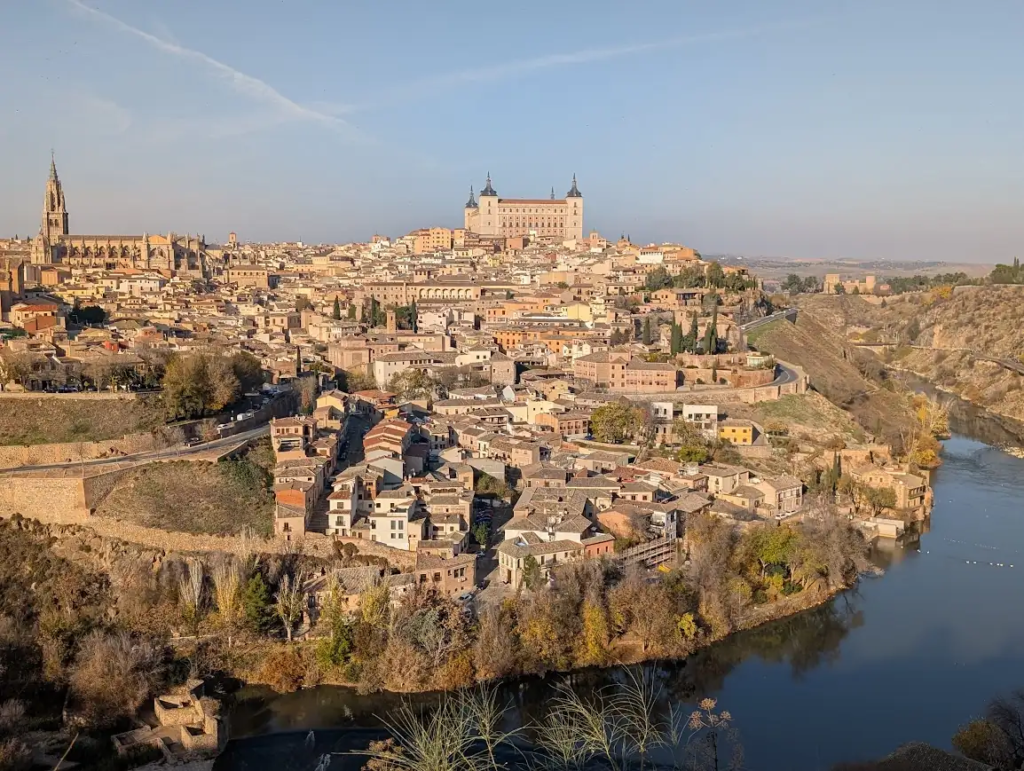
In the evening we started driving north toward Ávila, stopping for the night just before the city in an area that looked like a future construction site for more houses, but still totally quiet and with no people around.
Day 7 – Ávila, Salamanca
In the morning we visited Ávila, famous for its medieval city walls, intact from the 11th century. It was a rainy day, so our memories aren’t the best, but the view from Cuatro Postes Lookout was great.
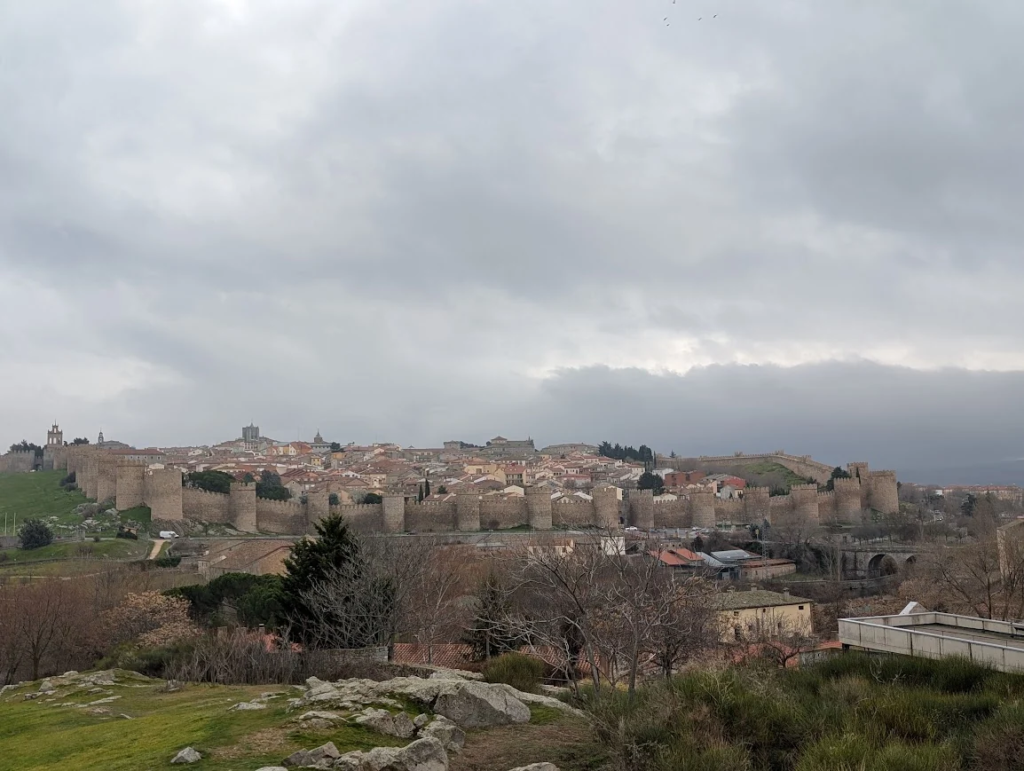
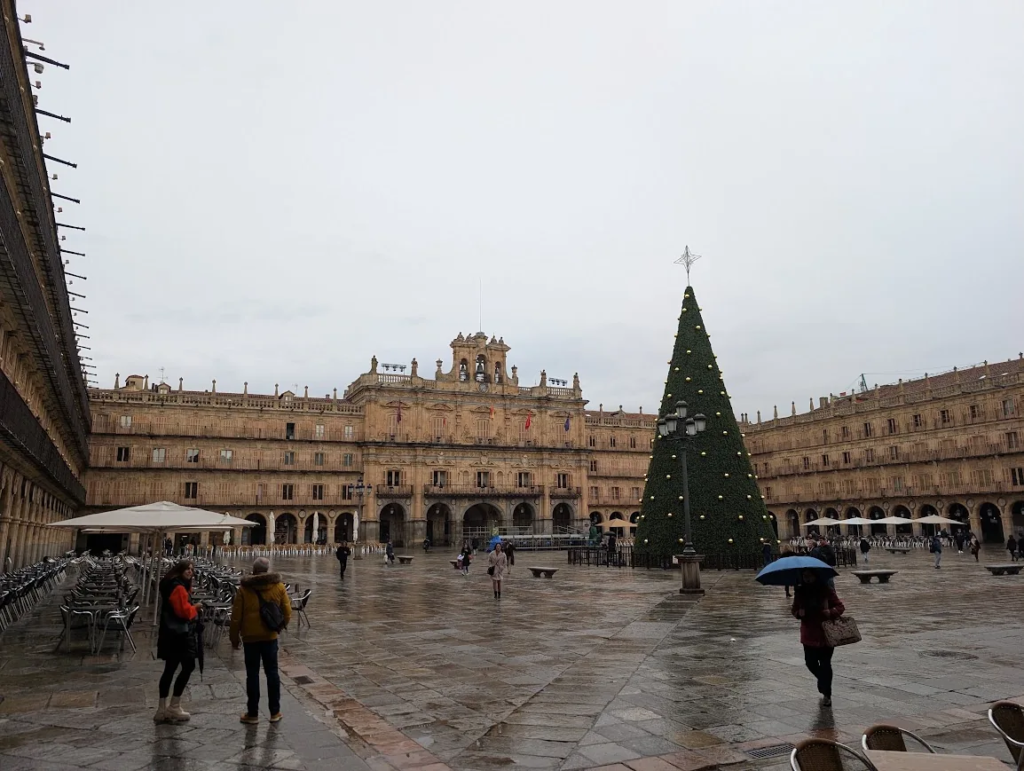
The other destination for the day was Salamanca, a city we had heard many good things about before coming, but unfortunately it was still mostly rainy. It’s home to the oldest university in Spain, which is still attended by many, driving the city’s character and economy. Plaza Mayor is considered one of the most beautiful main squares in Spain.
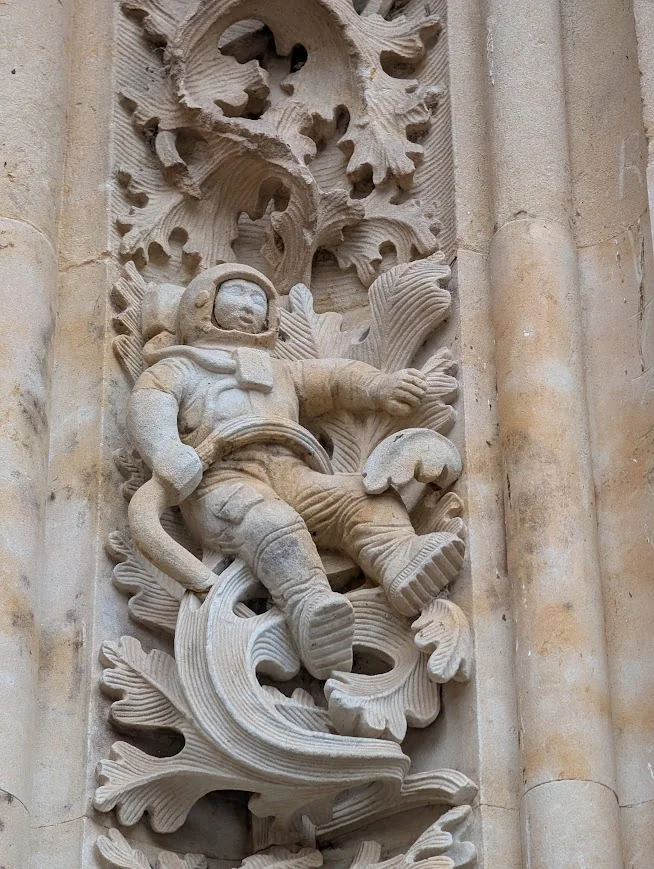
The New Cathedral, built alongside the older one, has a gateway carving added during the 1992 restoration that includes an astronaut, a modern-day mason’s joke that’s become one of the city’s well-known quirks. We didn’t pay to enter (€10), but went in through the door to where the tickets are sold, from which you can already see most of the interior. This trick worked in many other cathedrals in Spain.
Day 8 – Zamora
After spending another night in the car, we drove on to the nearby Zamora, where we spent a few hours visiting old Romanesque churches and its castle (free), walking by the river, and stopping at a couple of nice viewpoints. We actually really liked that city. It didn’t feel as crowded as Salamanca and Toledo, and the weather had finally turned, which obviously helped us appreciate its beauty.
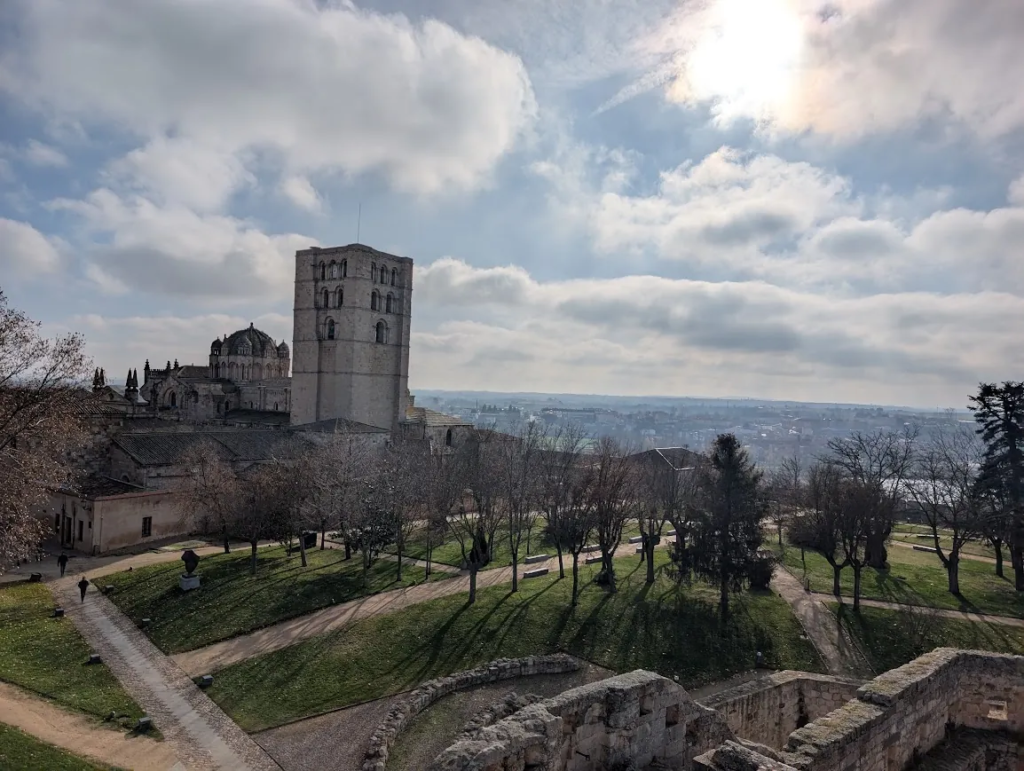
In the afternoon we started driving west and finally crossed back into Portugal.
Season
We did this leg in December, continuing from Andorra and the Pyrenees. Central Spain’s plateau is cold and dry in winter regardless of elevation. Madrid averaged around 11°C (52°F) for highs and 3°C (37°F) for lows during our visit, with similar numbers in Zaragoza and Toledo. Segovia and Ávila run even colder. Both sit above 1,000 m, and Ávila, at 1,132 m with a real chance of frost overnight.
Low season runs roughly November to March. Segovia, Toledo and Madrid were the only stops that felt busy. Everywhere else, including Lleida, Zaragoza, Soria, Ávila, Salamanca and Zamora, was quiet.
I’d avoid July–August. Madrid and Toledo regularly hit highs above 35°C (95°F), and Toledo in particular has a reputation as one of the hottest cities in Spain.
Practical
Currency
Euro. Cards are accepted almost everywhere, but carry some cash for parking attendants and street vendors. If you’re coming from a non-euro country, use Revolut to avoid conversion fees. There’s a 1% weekend markup, but you can avoid it by exchanging currencies in the app beforehand.
SIM
Any EU SIM works under Roam Like at Home – no need to buy a local one. If you don’t have one, check eSIMDB, filter by the amount of data you need and your trip length, then sort by price.
Language
Spanish. English is widely spoken in hospitality and tourism, but not reliably outside of it. Learn at least a few phrases:
- por favor – please
- hola – hello
- buenos días – good morning/good day
- buenas tardes – good afternoon
- buenas noches – good evening/good night
- gracias – thank you
Tips Summary
- Cheapest Rentals: Search via DiscoverCars – small cars from €94.46/week at Madrid Airport at the time of writing.
- Sleeping in a Car: Legal in Spain as long as you’re legally parked and don’t display any camping behavior outside the vehicle. Local ordinances sometimes ban it in natural parks and on coastal beaches.
- Free Roads Instead of Tolls: Central Spain’s main autovías (A-2, A-42, A-50, A-66) are toll-free, and the AP-2 between Lleida and Zaragoza has been free since 2021. We bypassed the toll roads around Madrid and the Sierra de Guadarrama entirely on free national roads and mountain passes.
- Cheap Fuel: Diesel was as low as €1.30/L in December 2025. Unstaffed stations like Plenoil and Ballenoil undercut the big brands. Google Maps doesn’t reliably show real-time fuel prices in Spain – we used the Gasall app instead.
- Madrid Parking Without the ZBE: Park in Pozuelo de Alarcón and take the train in. It sits outside Madrid’s Low Emission Zone, so no environmental sticker or registration needed, and street parking is free.
- Museo del Prado: Free during the last two hours of opening, every day. Regular admission is €15.
- Temple of Debod: Free to visit, but you need to book a timed-entry slot in advance.
- Royal Palace of Madrid: Free Monday to Thursday during the last two hours of operation, for EU and Latin American citizens with ID or a residence/work permit. Regular admission is €18.
- Museo Reina Sofía: Same deal – free during the last two hours, saving the €12 admission. Pre-book on their official website and skip the queue entirely.
- Salamanca Cathedral Trick: Skip the €10 ticket and walk in through the door where tickets are sold – you can already see most of the interior from there. Worked at several other cathedrals in Spain too.
The Budget System
I keep daily travel costs under €30 using two methods:
● €3/Day Rental Car Guide
● Sleeping in Rental Cars
One week of travel cost me less than a day of work in Australia.